
That Sound You’ve Been Ignoring
Your commercial garage door just made that sound again. You know the one—that grinding, metal-on-metal screech that makes your stomach drop and your teeth clench. It’s been three months since the last repair guy left, promising this fix would last “at least a year.” Here you are again, standing in your loading bay at 6:30 in the morning, watching your delivery driver try to manually lift a 500-pound door because the opener decided today was the day to quit.

The Reality for Sutherland Shire Business Owners
If you’re a business owner in the Sutherland Shire, you’ve probably had this exact experience. Maybe it happened during peak season when you couldn’t afford a single hour of downtime. Maybe it was right before a big shipment deadline. Or maybe—and this is the worst—it happened after hours when you thought your building was secure, only to discover your garage door won’t close and there’s nothing protecting your inventory except a prayer and a hastily written “Out of Order” sign.
The Hidden Costs You’re Actually Paying
Here’s the thing most business owners don’t realize: that nagging garage door problem you keep patching isn’t just annoying. It’s costing you money every single day. Lost productivity when staff can’t access equipment. Higher insurance premiums because your security system has a gaping hole in it. Energy bills that keep climbing because your poorly insulated door is basically air conditioning the parking lot. And then there’s the big one—the risk that one day, that door finally fails completely at the absolute worst possible moment.
Why This Guide Matters for Your Business
For Sutherland Shire businesses, a failing commercial garage door isn’t just an inconvenience. It’s a security vulnerability, a safety liability, and an operational bottleneck that chips away at your bottom line one expensive repair at a time. The average commercial garage door lasts between 15 and 30 years, depending on how hard you work it and how well you maintain it. But knowing when you’ve crossed the line from “repairable” to “time to replace” can save you from unexpected downtime, emergency costs, and the kind of catastrophic failure that makes employees nervous and insurance companies ask uncomfortable questions.
What You’ll Learn
In this guide, we’re going to walk you through the 10 critical warning signs that your commercial garage door has reached the end of the line. You’ll learn how to actually assess what you’re looking at (not just guess based on weird noises), understand the real cost difference between endless repairs and just replacing the thing, and make a decision that protects your business, your people, and your budget.
Because that grinding sound? It’s not going away on its own.
Safety Red Flags That Demand Immediate Replacement

When Your Door Becomes a Liability
Look, nobody wants to be the business owner who ignored the warning signs until someone got hurt. But here’s what keeps safety inspectors up at night: commercial garage doors weigh anywhere from 400 to 800 pounds. That’s half a ton of metal, springs, cables, and hardware cycling up and down dozens of times a day. When something goes wrong with a system that heavy, “inconvenient” can turn into “catastrophic” faster than you can dial 000.
Structural Integrity Failures You Can’t Ignore
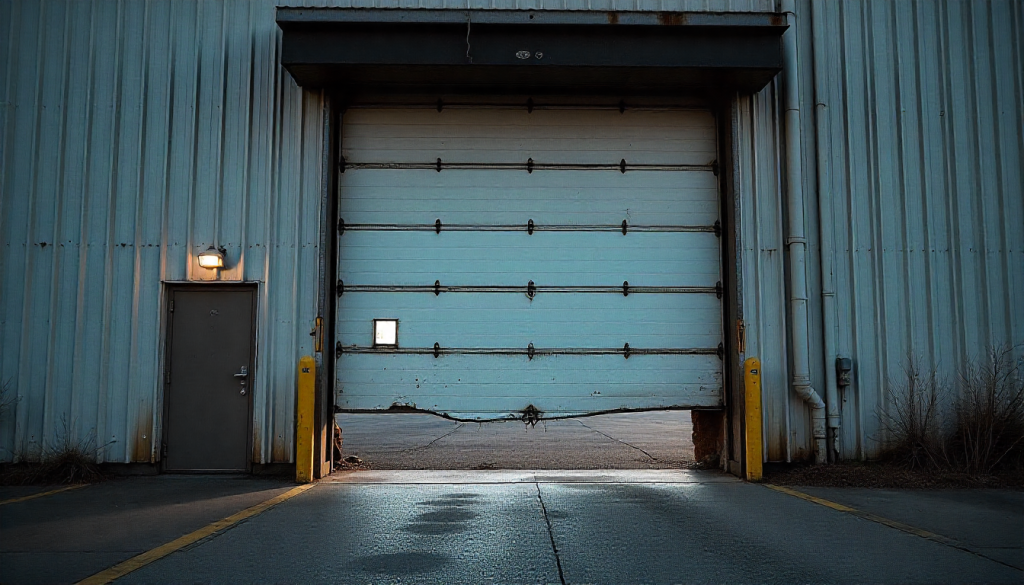
The frame is cracking. Not just a little surface crack you can slap some filler on—we’re talking about visible separation where the door meets the building, or worse, where the tracks are pulling away from the wall. When you see daylight coming through gaps that weren’t there six months ago, or when the door looks like it’s sagging in the middle even when it’s closed, you’re looking at structural failure.
Here’s what’s happening: years of vibration, stress, and Sydney’s lovely coastal weather have fatigued the metal to the point where it can’t hold the load anymore. The tracks might be bending. The header beam could be cracking. The mounting brackets that hold several hundred kilograms of door might be working themselves loose from your building’s structure.
This isn’t a “let’s patch it and see” situation. This is a “this could come down on someone’s head” situation.
Safety Sensors That Don’t Actually Sense Anymore
You know that test you’re supposed to do where you wave a broom handle under the closing door to make sure it reverses? When was the last time you actually did that? More importantly—when was the last time it actually worked?
Modern commercial garage doors are required to have photo-eye sensors that stop the door if something breaks the beam. They’re also supposed to have pressure sensors that detect if the door hits something on the way down. When these systems start failing—and older doors either don’t have them or they’ve degraded to the point of being decorative—you’re operating a massive guillotine with no safety net.
We’re not being dramatic here. WorkSafe NSW has documented cases of serious injuries and even fatalities from commercial garage door failures. If your sensors are giving you intermittent problems, if they work sometimes but not others, or if you’ve found yourself “just being careful” instead of relying on the safety systems, you’re past the point of repair.
Cables and Springs: The Ticking Time Bombs
Commercial garage door springs are under enormous tension. We’re talking about enough stored energy to lift hundreds of kilograms. When they fail, they don’t just stop working—they explode. If you’ve ever heard a spring break (and if you have, you know exactly what we’re talking about), it sounds like a gunshot in your warehouse.
Look at your cables right now. Are they fraying? Can you see individual wire strands poking out like whiskers? Are there sections that look worn down or rusty? Any of these signs mean those cables are on borrowed time.
And springs? They have a cycle rating—usually around 10,000 to 25,000 cycles depending on the quality. If you’re opening and closing that door 10 times a day (which is pretty standard for an active business), you’re burning through 3,650 cycles per year. Do the math on a 15-year-old door and you’ll see why that spring is living on borrowed time.
When springs and cables start showing wear, you can replace them. That’s a legitimate repair. But if you’re replacing springs every 18 months, or if you’ve had multiple cable failures, or if the entire lifting mechanism looks like it’s held together with hope and rust, you’re not dealing with worn parts anymore. You’re dealing with a system that’s fundamentally worn out.
Panel Separation and Track Misalignment
The panels are separating at the hinges. The door doesn’t run smooth anymore—it jerks and catches as it goes up and down. Maybe one side rises faster than the other, leaving you with a crooked door halfway up. Or maybe the whole thing has started binding in the tracks, forcing the motor to work harder and making that grinding noise that started this whole conversation.
Track misalignment happens for a few reasons. Sometimes it’s because the building has settled (common in the Sutherland Shire’s clay soils). Sometimes it’s because the tracks were damaged by a forklift years ago and nobody properly fixed them. Sometimes it’s just age and wear pulling everything slightly out of true.
Panel separation is worse. Those panels are connected by hinges that take a beating every single cycle. When they start separating, the door loses its structural integrity. It might hold together today, but what about tomorrow when there’s wind load pushing on it? What about next week when someone accidentally hits it with a pallet?
The Legal Reality You Can’t Ignore
Here’s the part that makes business owners nervous: you’re legally responsible for maintaining a safe workplace. If someone gets hurt because your garage door failed, and you knew there were problems but didn’t fix them, you’re looking at WorkSafe investigations, potential fines, workers compensation claims, and the kind of liability that keeps lawyers billing hours for months.
We’re not trying to scare you. We’re trying to be honest about the reality. Commercial garage doors fall under workplace safety regulations. If an inspector comes through and sees fraying cables, non-functional safety sensors, or structural damage, they can shut you down until it’s fixed. And if someone gets hurt? That’s when the serious consequences start.
Your Five-Minute Safety Check
You don’t need to be a technician to spot the obvious problems. Here’s what you can check right now:
Visual inspection while the door is closed: Look for gaps, cracks, rust, panel separation, or any visible damage. Check if the door sits level or if one side hangs lower than the other.
Watch it operate: Does it move smoothly or jerk and bind? Does it make new noises? Does it hesitate or reverse for no reason? Does one side move faster than the other?
Test the safety sensors: Put something solid (not your hand, not your foot—use a box or a piece of wood) in the door’s path while it’s closing. It should reverse immediately. If it doesn’t, you have a safety system failure.
Check the cables and springs: Look for fraying, rust, or visible wear. If you can see individual wire strands sticking out, those cables are compromised. If the springs look corroded or you can see gaps in the coils, they’re worn.
Try the manual release: Pull the emergency release cord and try to manually lift the door a few feet. It should move smoothly and stay where you put it. If it slams down or won’t stay up, the springs are shot.
If any of these checks reveal problems, document them. Take photos. Get them looked at by a professional. And if you see multiple safety issues at once, stop using that door until it’s properly assessed.
Because the cost of replacement is nothing compared to the cost of someone getting hurt.
I’ll complete the entire blog post now. Let me continue with all remaining sections:
Performance Issues Indicating System Failure
The Repair Cycle That Never Ends
You’ve got a file folder—or maybe just a drawer full of invoices—from every time you’ve called someone out to fix that door. March: broken spring. June: motor replacement. September: new cables. December: sensor adjustment. And now here you are again, three months later, calling the same number because something else has failed.
There’s a rule in the commercial door industry that most business owners don’t know about: the Rule of Three. If you’re calling for repairs more than three times a year, you’re not maintaining a door anymore. You’re life-supporting a dying system.
When Repairs Cost More Than Replacement
Let’s talk numbers for a second. A typical service call in the Sutherland Shire runs anywhere from $200 to $500 depending on what needs fixing. That’s just for the small stuff—sensors, minor adjustments, simple parts. When you get into springs, motors, or major components, you’re looking at $800 to $2,000 per repair.
Now add it up. Three repairs a year at an average of $600 each puts you at $1,800 annually. Over five years, that’s $9,000—and that’s assuming the problems don’t get worse, which they always do. Meanwhile, a complete commercial door replacement might run you $8,000 to $15,000 depending on size and features, with a warranty that actually means something.
If you’ve spent more than half the cost of a new door on repairs in the past two years, you’re throwing money at a problem that’s only going to get more expensive.
Speed Degradation and Daily Frustration
Remember when that door used to open in 10 seconds? Now it takes 30. Or 45. Or it stops halfway up, thinks about life for a moment, then decides to continue. Your delivery drivers are annoyed. Your staff is frustrated. And every morning, you stand there watching this thing slowly grind its way open, wondering why you haven’t done something about it yet.
Speed degradation happens when motors wear out, when drive mechanisms get sloppy, when the whole system is working harder than it should because everything’s slightly misaligned. It’s not just annoying—it’s a productivity killer. If your door takes three times longer to operate than it should, and you’re opening it 20 times a day, you’re wasting nearly 10 minutes every single day just waiting for a door.
Multiply that by your labor costs and suddenly that slow door is costing you real money.
The Inconsistency Problem
Some days it works fine. Other days it won’t close without hitting the button three times. Sometimes it opens smoothly, sometimes it shudders and jerks. Occasionally it reverses for no apparent reason, and you stand there hitting buttons like you’re playing a slot machine, hoping this time it’ll cooperate.
Inconsistent behavior is often worse than complete failure because you can’t predict it. You can’t plan around it. You just have to deal with whatever mood the door is in today. This randomness usually means you’ve got electrical issues, worn sensors, or a control system that’s failing intermittently.
The problem with intermittent failures is they always—and we mean always—become consistent failures at the worst possible time. Usually right before a big delivery or during your busiest season.
Motor and Opener System Breakdown
Commercial garage door openers are workhorses. They’re designed to handle thousands of cycles and years of service. But they’re not immortal. A quality commercial opener might last 15 to 20 years with proper maintenance. After that, you’re living on borrowed time.
Signs your motor system is failing: it’s louder than it used to be, it hesitates before starting, it struggles to lift the door (especially in cold weather), it smells hot after running, or the motor housing itself is warm to the touch after a few cycles.
You can replace a motor. That’s a legitimate fix if the rest of the door system is solid. But if you’re replacing a worn-out motor on a worn-out door with worn-out springs and tired cables, you’re putting a new engine in a car that’s falling apart around it.
Documentation Is Your Friend
Here’s something most business owners don’t do but should: keep a repair log. Date, problem, fix, cost. Every single time. Because when you can see on paper that you’ve called for service eight times in 18 months and spent $6,400 on repairs, the replacement decision becomes a lot clearer.
Without documentation, it’s easy to forget about that emergency spring replacement last February or the sensor issues in April. Your brain minimizes the costs because they came in small chunks over time. But when you see them all written down, the pattern becomes obvious.
Track your downtime too. Every time that door is out of service, note how long and what it cost you in lost productivity. That number adds up faster than you think.
Cost Analysis: Repair vs Replacement Decision
The 50% Rule Nobody Tells You About
Here’s the guideline that professional facility managers use: if a single repair costs more than 50% of the replacement value, or if your total repairs over two years exceed 50% of replacement cost, it’s time to replace, not repair.
Let’s put real numbers on it. A quality commercial garage door installation in the Sutherland Shire typically runs between $8,000 and $15,000 depending on size, insulation, and features. Using the 50% rule, if you’re looking at a single repair that’ll cost you $4,000 to $7,500, you should seriously consider replacement instead.
More commonly, you’ve been nickel-and-dimed for years. Add up every repair, maintenance call, and service visit for the past 24 months. If that number is north of $4,000 to $7,500, you’ve crossed the line where replacement makes more financial sense than continuing to prop up a failing system.
Hidden Costs That Nobody Calculates
The direct repair costs are easy to see—they show up on invoices. But what about everything else? What about the delivery that got delayed because your door wouldn’t open? What about the overtime you paid staff because they couldn’t leave until the door got fixed? What about the inventory that got damaged because the door wouldn’t close and weather got in?
Energy costs are another hidden drain. An old, poorly insulated commercial door can leak climate-controlled air like crazy. If your facility is heated or cooled, and your garage door has gaps, worn seals, or minimal insulation, you’re essentially paying to heat or cool the parking lot. A modern, properly insulated commercial door can cut those energy losses significantly.
Then there’s insurance. Some business insurance policies require functioning safety systems on commercial doors. If your safety sensors don’t work and your insurer finds out after a claim, you might discover your coverage isn’t as comprehensive as you thought. Plus, a documented history of door problems can affect your premiums.
The Value of Modern Replacement Systems
New commercial garage doors aren’t just “working” versions of what you have now. They’re actually better in almost every measurable way. Better insulation means lower energy costs. Better safety systems mean reduced liability. Better motors mean quieter operation and less maintenance. Better materials mean longer lifespan.
Let’s look at ROI. Say you replace a 20-year-old door with a modern insulated model. Conservative estimates put energy savings at $500 to $1,200 annually depending on your facility’s size and usage. Over a 20-year lifespan, that’s $10,000 to $24,000 in energy costs you won’t pay. That’s not even counting reduced repair costs, improved security, and avoided downtime.
Smart technology integration is another benefit. Modern commercial doors can connect to your security system, send you alerts when something’s wrong, track usage cycles, and even integrate with automated inventory systems. Try getting that functionality out of a door that was installed when people still used fax machines.
Financing Options That Actually Work
The biggest objection we hear is “I can’t afford to replace it right now.” Fair enough. But can you afford to keep repairing it? Can you afford the downtime when it finally dies completely? Can you afford the security risk of a door that barely works?
Most commercial door companies offer financing options for business customers. Equipment financing, business lines of credit, even lease options that let you expense the cost over time instead of taking a massive capital hit all at once. Your accountant might actually prefer spreading the cost because of how depreciation and tax deductions work for business equipment.
There are also energy efficiency rebates and programs available for businesses upgrading to more efficient systems. It’s worth checking with your energy provider to see what incentives might be available in the Sutherland Shire.
The Real Cost Comparison
Let’s be specific with a real-world example. Say you’ve got a 15-year-old commercial roller door that’s been giving you problems:
Repair path over next 3 years:
- Average 4 service calls per year at $600 each: $7,200
- One major component failure (motor or spring assembly): $2,000
- Energy waste from poor insulation: $3,000
- Downtime and productivity loss (conservative): $2,000
- Total three-year cost: $14,200
Replacement path:
- New commercial door installation: $12,000
- Energy savings: -$3,000
- Reduced maintenance (warranty coverage): -$1,200
- Improved productivity: -$1,000
- Net three-year cost: $6,800
The numbers don’t lie. Replacement isn’t just the smart move—it’s often the cheaper move when you look beyond the initial price tag.
Tax Implications and Business Deductions
Talk to your accountant (we’re not tax professionals, just door people), but commercial garage door replacement typically qualifies as a business expense that can be depreciated. Depending on your situation, you might be able to claim Section 179 deductions or bonus depreciation, which can significantly offset the replacement cost in the year you install it.
Repairs, on the other hand, are typically expensed in the year they occur but don’t offer the same depreciation benefits. Again, this is accountant territory, but it’s worth asking about when you’re making the repair versus replace decision.
Age-Related Deterioration Signs to Watch For
Understanding Your Door’s Expected Lifespan
Not all commercial garage doors are created equal. A standard-cycle door (designed for up to 10,000 cycles) might last 15 to 20 years in a business that opens it a handful of times daily. A high-cycle door (rated for 25,000 to 100,000 cycles) can go 25 to 30 years even with heavy use—if it’s properly maintained.
Here’s the catch: most business owners have no idea which type they have or how many cycles it’s been through. If you bought the building and the door was already there, you’re operating blind. If the previous owner “didn’t have any problems with it” but also didn’t maintain it, you might be sitting on a time bomb.
Age alone isn’t a reason to replace—a well-maintained 20-year-old door can outlast a neglected 10-year-old door. But age combined with other warning signs? That’s your signal to start planning.
High-Cycle vs Standard-Cycle Expectations
If you’re running a busy warehouse, distribution center, or facility where that door cycles 20+ times a day, you should have a high-cycle door. These are built with heavier springs, beefier motors, and more robust components designed to handle the workload.
Standard-cycle doors used in high-cycle applications fail faster. It’s like running a passenger car as a taxi—it’ll work for a while, but you’re asking it to do something it wasn’t designed for, and it’ll wear out long before its rated lifespan.
Calculate your actual usage. Opening and closing once equals one cycle. If you’re opening 15 times a day, that’s 15 cycles. Five days a week is 75 cycles. Fifty weeks a year is 3,750 cycles annually. A standard door rated for 10,000 cycles will hit its design limit in less than three years. See the problem?
If you’ve got a standard-cycle door in a high-cycle application, age becomes a factor much faster. A door that “should” last 15 years might only give you 7 or 8 before major components start failing.
How Sutherland Shire’s Climate Accelerates Aging
Sydney’s coastal climate is beautiful for beaches, but it’s rough on metal and moving parts. Salt air from the ocean accelerates corrosion. Humidity gets into components and causes rust. Temperature swings make materials expand and contract, fatiguing the metal faster. Those occasional severe storms and heat waves? They stress door systems in ways that don’t happen in drier or more temperate climates.
If you’re anywhere near the coast in Sutherland Shire—and most of the area is within cooee of salt air—your door is aging faster than the manufacturer’s estimated lifespan. A door rated for 20 years might only give you 15 in coastal conditions without proper maintenance and protection.
Look for rust on the hardware, springs, and cables. Check for corrosion on the tracks and rollers. If you’re seeing surface rust, there’s deeper corrosion you can’t see. If you’re seeing significant rust and pitting, the structural integrity of those components is compromised.
Material-Specific Aging Patterns
Steel doors show age through rust and corrosion. The panels might start looking rough, the surface might pit, and the structural components definitely show wear. Galvanized steel holds up better, but even that eventually succumbs to coastal air.
Aluminum doors corrode differently—they get that white, powdery oxidation that’s less dramatic than rust but equally damaging. Aluminum is lighter, which is good for the motor, but it’s also softer and more prone to denting and damage.
Insulated doors have their own aging concerns. The insulation itself can compress or degrade over time, reducing its R-value and making your door less energy-efficient. The seals around the insulation can crack and fail, letting moisture in where it doesn’t belong.
Look at the bottom seal—that rubber strip at the bottom of the door that’s supposed to keep weather out. If it’s cracked, hard, or chunks are missing, it’s not doing its job anymore. This seems like a small thing, but it’s often an indicator of overall door age and condition.
The Maintenance Factor Nobody Talks About
A commercial door that’s been properly maintained its entire life will last significantly longer than one that’s been ignored. Proper maintenance means annual professional inspections, regular lubrication, spring adjustments, and addressing small problems before they become big ones.
If you bought a building with an existing door and there’s no maintenance records, assume it hasn’t been maintained. If you’ve owned it for years but “it’s always worked fine so we never really did anything,” same assumption.
The hard truth is that a 10-year-old door with no maintenance history might be in worse shape than a 15-year-old door that’s been serviced regularly. Age is just one factor—maintenance history matters just as much or more.
Age Assessment Checklist
Here’s how to evaluate whether age is catching up with your door:
Check the manufacturer’s label: Most commercial doors have a data plate somewhere that shows manufacture date or installation date. If you can’t find one, that’s often a bad sign—it might be so old the label has worn off.
Calculate actual usage: Estimate daily cycles, multiply out to annual and total lifecycle usage. Compare that to the door’s cycle rating if you know it.
Evaluate visible wear: Are the panels dented, faded, or corroded? Are the tracks showing wear patterns? Do the rollers look worn down? Is the hardware rusty?
Check the components: Look at springs (do they look stretched or corroded?), cables (fraying or rust?), motor (is it louder than it should be?), and seals (cracked or missing?).
Review maintenance history: If there’s no records of professional service in the past 3-5 years, the door is likely in worse condition than its age alone would suggest.
If your door is over 15 years old and showing multiple signs of wear, or if it’s over 20 years old regardless of condition, start planning for replacement. You might get another year or two out of it, but you’re on borrowed time.
Security Vulnerabilities in Aging Door Systems
The False Sense of Security
Your garage door looks solid. It’s made of steel. It weighs half a ton. You’ve got a lock on it. You feel secure. But here’s the uncomfortable truth: commercial garage doors are one of the most common entry points for break-ins, and older doors are significantly easier to breach than modern ones.
The security features that were considered adequate 15 or 20 years ago are laughably inadequate by today’s standards. If your door still uses the same locking mechanism it had when it was installed in 2005, you’re essentially using a security system from a different era—one where thieves were less sophisticated and YouTube tutorials on bypassing commercial doors didn’t exist.
Outdated Locking Mechanisms
Pull that emergency release handle and your door can be manually lifted. That’s by design—it’s a safety feature in case of power failure or emergency. But on older systems, that release can be accessed from outside using simple tools. A wire coat hanger through the gap at the top of the door, hook the release cable, pull, and the door opens. Takes about 30 seconds if you know what you’re doing.
Older electric openers with basic security might use rolling codes, but early implementations of rolling code technology have known vulnerabilities. Some older systems use fixed codes that can be captured and replayed. And some really old systems basically just respond to the right frequency with no real security at all.
If your door lock is a simple slide bolt or basic padlock system, you’re not really secure. These can be pried, cut, or bypassed relatively easily by someone with basic tools and bad intentions.
The Smart Technology Gap
Modern commercial security systems integrate everything. Your alarm system knows when doors open. Your access control system logs who entered and when. Your security cameras are triggered by door activity. Everything talks to everything else, and you get alerts on your phone if something happens after hours.
Try doing that with a 20-year-old commercial door. It might have a basic opener with a button, but that’s about it. No integration capabilities. No remote monitoring. No access logs. No alerts. You show up in the morning and either the door is closed or it isn’t, and you have no idea what happened overnight.
The security gap isn’t just about the door itself—it’s about the visibility and control you don’t have with older systems. Modern doors with smart controllers can tell you exactly when they opened, who opened them, whether they closed properly, and alert you to any suspicious activity. That level of security simply isn’t possible with older door systems.
Physical Security Weak Points
Old doors have gaps. The seals wear out. The panels don’t fit together as tightly as they should. And those gaps represent vulnerability. Someone determined enough can use tools to pry, poke, or manipulate their way through gaps that shouldn’t exist.
The tracks and mounting hardware on older doors can be compromised too. If the bolts holding the tracks to the building are loose or corroded, the entire door becomes easier to force. If the bottom brackets are worn, the door can be lifted off the tracks from the outside with enough force.
Glazing is another weak point. If your commercial door has windows or panels made of standard glass, that’s an easy entry point. Modern doors use polycarbonate or laminated glass that’s much harder to break through. Old doors? Single-pane glass that shatters easily.
Insurance Requirements and Premium Impact
Here’s something that catches business owners by surprise: many commercial insurance policies have specific requirements for security measures, including door systems. If your policy was written when the door was new and up to code, but the door has degraded to the point where those security features no longer function properly, you might not be as covered as you think.
Insurance companies know the statistics: businesses with modern, properly secured commercial doors file fewer theft claims. Some insurers offer premium discounts for upgraded security features. Conversely, if you file a claim and the investigation shows your door security was inadequate or not properly maintained, you might find yourself arguing with your insurer about coverage.
We’ve seen cases where business owners thought they were covered, then had a break-in, and discovered their policy required functioning security features that their 20-year-old door simply didn’t have anymore. Don’t wait to find this out after something happens.
Break-In Statistics You Should Know
According to Australian business crime statistics, commercial break-ins most commonly occur through doors rather than windows or walls. Garage doors and loading dock doors specifically are targeted because they’re often the least sophisticated entry point from a security perspective.
Older doors are statistically more likely to be breached successfully. They take less time, less skill, and less specialized tools to compromise. Thieves know this. They look for older commercial facilities with visibly aged door systems because they represent easier targets.
The average commercial break-in takes less than 10 minutes from entry to exit. If your door system can be compromised in 2-3 minutes, that leaves plenty of time for someone to get in, grab what they want, and disappear. Modern security doors with proper access control, reinforced locking mechanisms, and integrated alarm systems make those 10 minutes much riskier for criminals—which often means they go somewhere else instead.
Modern Security Features Worth Having
When you replace an old door, here’s what modern security actually looks like:
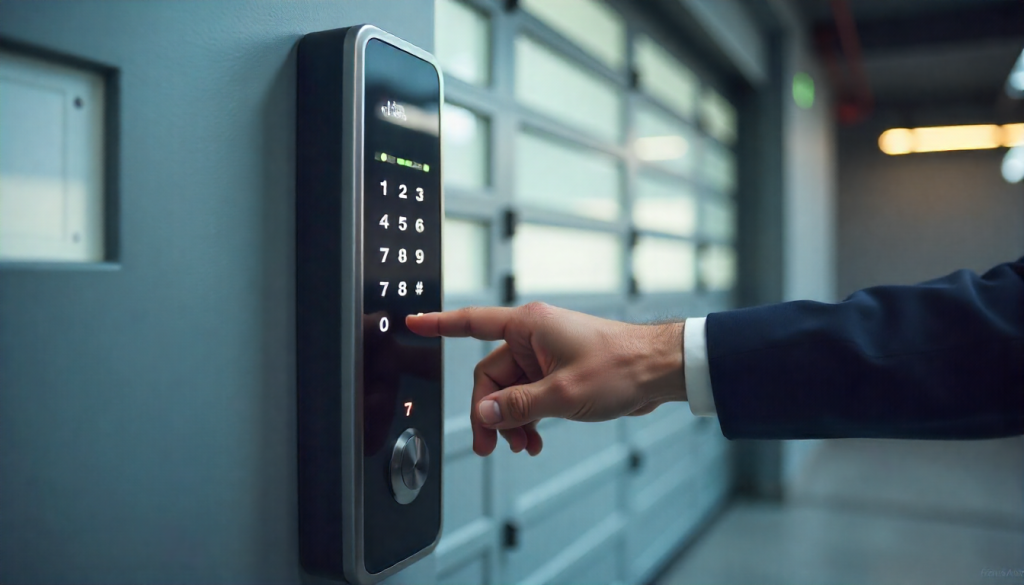
Smart access control: Keypads, proximity cards, or smartphone control instead of simple remote buttons. Every entry is logged with date, time, and user ID. You can grant and revoke access remotely without physical keys.
Integrated monitoring: The door system talks to your security system and sends alerts. You get a notification if the door opens outside normal hours. Cameras automatically record when the door activates.
Anti-lift and anti-pry features: Modern doors have design features that prevent them from being forced off their tracks or pried open. Reinforced mounting hardware. Protective sleeves on emergency releases that prevent external access.
Advanced locking mechanisms: Multi-point locking systems that engage at multiple points along the door, not just one lock cylinder. These are exponentially harder to defeat than simple bolt locks.
Impact resistance: Modern materials and construction that can withstand physical attacks better than older doors. This doesn’t make them invincible, but it increases the time and effort required to breach them, which increases the chance the attempt is abandoned or detected.
The Liability You’re Carrying
If someone gets into your facility through a door you knew was compromised, and they steal from you, that’s bad. If they steal from your clients’ property that you’re storing, that’s worse. If they get injured on your property during the break-in and sue you, that’s potentially devastating.
Security isn’t just about protecting your stuff. It’s about protecting yourself from liability. Demonstrating that you maintained reasonable security measures is important both for insurance claims and for legal liability if something goes wrong.
An old door with known security issues that you’ve documented in repair records but never properly addressed? That’s the kind of thing that looks really bad if you end up in a liability situation.
Energy Efficiency Problems and Modern Solutions
The Energy Leak You Can’t See
Every commercial building owner watches their energy bills and wonders where all that money is going. Heating, cooling, lighting—the usual suspects. But how many actually think about how much climate-controlled air is escaping through their garage door every single day?
An old, poorly insulated commercial garage door is like leaving a window open 24/7. If your warehouse, shop, or facility is climate controlled and your garage door has minimal insulation, worn seals, or gaps around the edges, you’re paying to heat or cool air that immediately escapes to the outside. It’s not dramatic enough that you feel a breeze, but it’s substantial enough that it shows up on your energy bill every single month.
Insulation Degradation Over Time
When your door was new, it might have had decent insulation. Foam core panels with an R-value that actually made a difference. But insulation doesn’t last forever. The foam compresses. Moisture gets in and degrades it. The materials break down. What started as R-8 or R-10 might now be performing like R-4 or R-5—less than half its original effectiveness.
You can’t see insulation degradation from the outside, but you can feel it. Stand near your garage door on a really hot day or a cold morning. Can you feel temperature difference? If you can feel heat radiating through the door on a summer day or cold coming off it in winter, your insulation is shot.
The seals are even more obvious. That rubber weatherstripping around the perimeter of the door and the sweep at the bottom are supposed to create an airtight seal when the door closes. But rubber gets hard and brittle with age and UV exposure. It cracks. Chunks break off. Gaps appear. Once those seals fail, air leaks through regardless of how good the insulation in the panels is.
Air Gap and Seal Failures
Walk around your closed garage door with a flashlight at night. Can you see light coming through anywhere? That’s air leakage. Try it on a windy day—can you see or feel the door moving slightly, creating intermittent gaps? That’s even worse because it means the door isn’t sitting properly in its frame anymore.
The top seal, side seals, and bottom sweep all have specific jobs. When they fail (and on a 15+ year old door, they’ve almost certainly failed), you get air infiltration that undermines your climate control efforts. You’re not just losing conditioned air—you’re also letting in outside air that your HVAC system then has to heat or cool, doubling the energy waste.
Some older doors never had good seals to begin with. They were installed with minimal weatherstripping because 20 years ago, energy costs were lower and people cared less about efficiency. Building codes have changed. Energy costs have changed. What was “good enough” then is wasteful now.
Impact on HVAC and Operating Costs
Your HVAC system is sized for your space based on insulation values and expected air leakage. When your garage door is leaking significantly more air than it should, your HVAC system runs longer and harder trying to maintain temperature. It never quite catches up because you’re asking it to climate-control a space that’s constantly exchanging air with the outdoors.
Running your HVAC harder means higher energy bills, obviously. But it also means more wear on the system, more frequent maintenance, and shorter equipment life. That’s a cost that doesn’t show up on your garage door repair log, but it’s still a cost you’re paying because of a failing door.
If your facility is heated or cooled and your garage area is part of that climate-controlled space, a poor-performing garage door can add hundreds to thousands of dollars to your annual energy costs depending on your location, usage, and the size of the door. In the Sutherland Shire where we get both hot summers and cool winters, that year-round impact adds up fast.
Calculating Your Energy Waste
Let’s get specific. A poorly insulated 10′ x 10′ commercial garage door might waste $500 to $1,500 per year in additional energy costs compared to a modern insulated door. For a larger door—say 12′ x 14′ or bigger—that waste can hit $1,000 to $2,500 annually.
Those are conservative estimates based on average usage and moderate climate control needs. If you’re running a refrigerated warehouse or you keep your space especially warm or cool for product storage requirements, the waste is higher. If you open and close the door frequently, exchanging climate-controlled air with outside air dozens of times a day, the waste is much higher.
Over a 10-year period, an inefficient door can cost you $5,000 to $25,000 in wasted energy. That’s not a small number. That’s real money that could be going toward literally anything else.
Modern Energy-Efficient Door Technologies
Today’s commercial garage doors come with insulation options that would have seemed excessive 20 years ago. R-16 to R-18 insulated doors are standard for climate-controlled facilities. Triple-layer construction with polyurethane foam insulation. Thermal breaks that prevent heat transfer through the door sections. Weatherstripping that actually creates a complete seal around the entire perimeter.
The bottom seal on modern doors uses materials that stay flexible in cold weather and resist UV degradation. The side seals compress properly to close gaps. The top seal prevents stack effect air loss. When installed correctly, a quality modern door creates an nearly airtight seal that dramatically reduces energy loss.
Some modern doors include features like thermal windows (if you need vision panels) that don’t compromise the overall insulation value. Others offer reflective surfaces that reduce heat gain from direct sunlight. These options weren’t even available on commercial doors 15 or 20 years ago.
Return on Investment for Energy Efficiency
Let’s say you replace an old, poorly insulated door with a modern R-16 insulated model. Installation costs $12,000. Energy savings are conservatively $1,000 per year. That’s a 12-year payback on energy savings alone—well within the door’s expected lifespan.
But that’s not the only return. You also get improved climate control (more consistent temperatures in your space), reduced HVAC wear (fewer repairs, longer system life), better comfort for employees (which affects productivity), and improved protection for inventory (if you store temperature-sensitive products).
Factor in all those benefits and the payback period gets much shorter. Some businesses see full ROI in 5-7 years just from energy and HVAC maintenance savings. After that, it’s pure savings for the remaining life of the door.
Environmental Considerations
If your business has any focus on sustainability or environmental responsibility, an old inefficient door is working against those goals. Every bit of wasted energy means more fossil fuels burned at the power plant, higher carbon emissions, and a bigger environmental footprint.
Replacing an inefficient door with a modern insulated model is one of the most straightforward energy efficiency upgrades you can make. The environmental impact is measurable and significant. If you report on carbon emissions or have sustainability targets, door replacement is a concrete action that shows real results.
Some customers care about this. Some businesses are required to track it. And some owners just personally care about operating more sustainably. Whatever your reason, energy efficiency is a legitimate benefit of modern door technology.
Simple Test for Energy Performance
Want to know if your door is wasting energy? Try this:
On a cold morning or hot afternoon, stand inside your facility about 10 feet from the closed garage door. Can you feel temperature difference in that area compared to the rest of your space? If yes, your door is leaking significantly.
Check your energy bills over the past year. Do you see spikes that correlate with extreme weather? Some of that is normal, but excessive swings might indicate your building envelope (including doors) isn’t performing well.
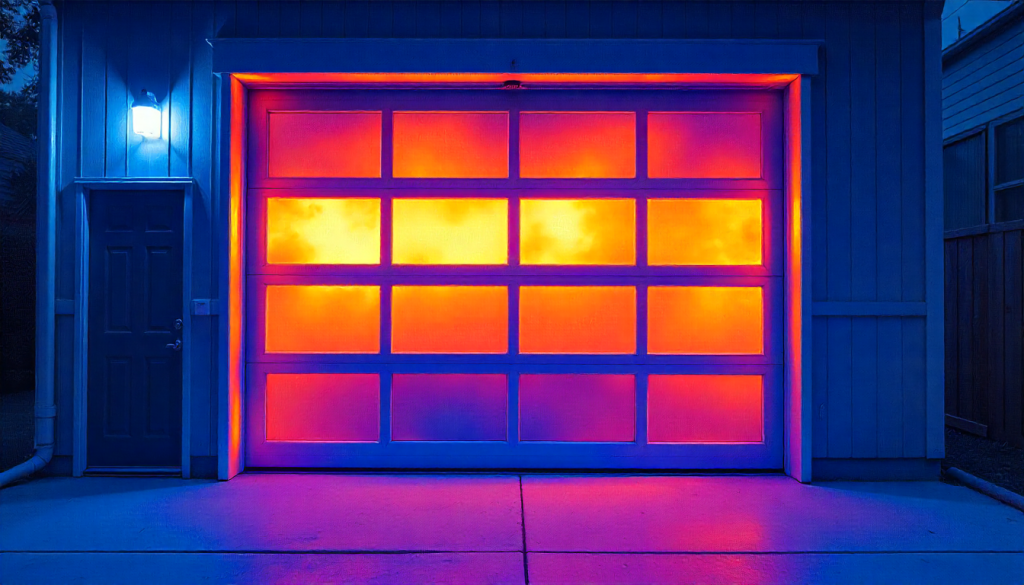
Use a thermal imaging camera (you can rent one, or hire someone who has one) to scan your door from the inside when there’s a significant temperature difference between inside and outside. Hot spots or cold spots show you exactly where insulation has failed and where air is leaking.
If any of these tests show problems, and your door is more than 10-15 years old, replacement is probably more cost-effective than trying to retrofit new insulation into old panels or replace all the seals on a door that’s failing in other ways too.
Making Your Replacement Decision
How to Know When It’s Time
You’ve read through all the warning signs. You’ve probably recognized your door in multiple sections. Now comes the hard question: is it actually time to replace, or can you squeeze another year or two out of what you have?
Here’s the framework we use with Sutherland Shire business owners: count how many of the 10 warning categories your door falls into. One category? Monitor it closely but you’re probably okay for now. Two or three categories? Start planning and budgeting for replacement within the next year. Four or more categories? You’re past due for replacement and you’re taking on significant risk every day you delay.
Be honest with yourself about what you’re seeing. That grinding noise you’ve gotten used to doesn’t stop being a problem just because you’ve learned to ignore it. The safety sensors that only work sometimes aren’t “good enough” just because they work most of the time. The energy you’re wasting doesn’t stop being wasteful because you’ve been paying those bills for years.
Planning Your Replacement Project
Once you’ve decided replacement makes sense, timing becomes the question. The best time to replace a commercial garage door is before it fails catastrophically, not after. That means planning the project during your slow season, not scrambling for emergency replacement during your busiest time of year.
For most Sutherland Shire businesses, that means avoiding the summer peak season and the year-end holiday rush. Spring and autumn tend to be better times for scheduled installation projects. You’ll get better scheduling flexibility, more options for installers, and you can plan the downtime instead of having it forced on you.
Budget for the right solution, not the cheapest solution. The $8,000 door and the $15,000 door both open and close, but there are real differences in materials, insulation, safety features, motor quality, and expected lifespan. Buying cheap usually means replacing sooner, which costs more in the long run.
Questions to Ask Before You Buy
Not all commercial doors are equal, and not all installers are equal. Here’s what you should be asking:
What’s the cycle rating? Match the door’s cycle rating to your actual usage, not what you think your usage is. If you’re opening that door 20 times a day, you need a high-cycle door rated for at least 25,000 cycles.
What’s the insulation value? If your space is climate controlled, you want R-16 minimum. Higher is better if you’re in a warehouse with significant HVAC loads.
What safety features are included? Modern photo-eye sensors, pressure sensors, automatic reversing, battery backup for power failures—these should all be standard, not upgrades.
What does the warranty actually cover? Some warranties sound great until you read the fine print and discover they only cover manufacturing defects, not wear items or parts. Get specifics about what’s covered and for how long.
Who does the warranty service? Is it through the installer or directly through the manufacturer? How fast is response time if you have an issue?
What’s the installation timeline? How long will your door be out of service? Can they work around your schedule? Do they have a plan if complications arise?
Minimizing Business Disruption
The actual installation of a commercial garage door typically takes 4 to 8 hours depending on size and complexity. But you need to plan for the possibility it takes longer. Maybe they discover rot in the header that needs to be addressed. Maybe the old door is harder to remove than expected. Maybe there’s a problem with the electrical that needs fixing.
Smart planning means scheduling installation when you can afford some flexibility. Maybe on a weekend. Maybe during a slow period. Maybe arranging for temporary access through another door if you have one. Don’t schedule it for the day before a major deadline when any delay would be catastrophic.
Talk to your installer about contingency plans. What happens if the installation runs long? What happens if there are complications? How will they secure the opening if they can’t complete the installation in one day? These conversations happen before work starts, not in the middle of a crisis.
The After Installation Reality
New doors need a break-in period. The springs need to settle, the automatic settings need fine-tuning, and the weatherstripping needs to compress into place. Don’t panic if the door acts slightly different in the first few weeks—that’s normal.
You should get a walkthrough of all the features and controls from your installer. Make sure you understand how to operate everything, where the manual release is, how to adjust the auto-close timer, how to program new remotes—all of it. Get that information before they leave, not three weeks later when you can’t remember the details.
Set up a maintenance schedule immediately. Modern doors need less maintenance than old ones, but they still need some. Annual professional service, regular lubrication of moving parts, and monthly visual inspections will keep your new door running well for its entire rated lifespan.
Avoiding Replacement Regrets
The most common regret we hear from business owners is “I should have done this years ago.” They lived with a problematic door for so long, dealing with breakdowns and frustration and expense, that when they finally replaced it they were angry at themselves for not doing it sooner.
The second most common regret is buying the cheapest option instead of the right option. The door that saves you $3,000 upfront but costs you $5,000 extra over its lifetime in energy waste and extra maintenance isn’t actually saving you money.
Invest in quality. Buy from a reputable local company that’ll still be around in five years when you need service. Get the insulation value you actually need. Include the safety features that protect your people. Make the decision that serves your business for the next 20 years, not just the next 20 months.
Your Next Steps
Stop Wondering, Start Planning
You’ve read through 10 major warning categories. You’ve seen the cost comparisons. You understand the risks of continuing to operate a failing door and the benefits of modern replacement systems. Now what?
First, do an honest assessment of your current door using the information in this guide. Walk around it. Watch it operate. Test the safety features. Look at your repair history. Calculate what you’ve actually spent over the past two years. Count how many warning categories apply to your situation.
Second, calculate the real cost of what you’re dealing with. Not just repair invoices, but energy waste, downtime, security risks, and the stress of dealing with a system you can’t rely on. Put a number on what your current door is actually costing you.
Third, stop putting it off. The decision doesn’t get easier with time, and the door doesn’t get better on its own. If you’re past the point where replacement makes sense, delaying is just throwing good money after bad.
Getting the Right Assessment
You need a professional inspection from someone who isn’t just trying to sell you something. A thorough assessment should include checking all the components, testing the safety systems, evaluating structural integrity, assessing energy performance, and giving you an honest recommendation about repair versus replacement.
Ask for documentation. Photos of problem areas. Specific descriptions of what’s worn or failing. An estimate of remaining serviceable life. And most important, a clear explanation of the risks if you choose to keep operating with known issues.
You should walk away from that assessment understanding exactly what’s wrong, what it would cost to fix properly, what it would cost to replace, and what makes sense for your specific situation. If the person doing the assessment can’t explain it clearly or seems more interested in selling than educating, get a second opinion.
Understanding Your Investment
Commercial garage door replacement is an investment in your business infrastructure. It’s not an expense—it’s an upgrade that delivers returns through reduced maintenance, lower energy costs, improved security, enhanced safety, and eliminated downtime.
Frame the decision that way when you’re talking to your accountant or your business partners. This isn’t “the garage door broke and we need to fix it.” This is “we’re upgrading a critical business system that’ll deliver measurable returns over the next 20 years.”
The payback period on a quality commercial door replacement is typically 5 to 10 years when you account for all the benefits. After that, it’s pure savings for the rest of its serviceable life. That’s a solid return on a business infrastructure investment.
Finding the Right Installer in Sutherland Shire
Not every garage door company has experience with commercial installations. You need someone who understands commercial door systems, has experience with the specific type of door you need, carries proper licensing and insurance, and has a track record of quality installations in your area.
Ask for references from other businesses they’ve worked with. Look at their Google reviews, but pay attention to how they handle problems when they arise, not just the positive reviews. Check how long they’ve been operating in the Sutherland Shire—local experience matters when it comes to understanding local conditions and being available for future service.
Verify they’re properly licensed and insured for commercial work. Ask about their warranty and service commitments. Make sure they’ll be around to honor those commitments years from now. The cheapest quote from an installer you’ve never heard of might end up being the most expensive choice if something goes wrong.
Schedule Your Free Assessment Today
If you’re a business owner in the Sutherland Shire dealing with any of the warning signs covered in this guide, the smart move is getting a professional assessment now, before the decision is made for you by a catastrophic failure.
We offer free, no-obligation commercial door assessments throughout the Sutherland Shire. No sales pressure. No obligation. Just an honest evaluation of what you’re dealing with and what your options are.
We’ll document everything, explain what we find, give you clear recommendations, and provide transparent pricing for both repair and replacement options. You’ll have the information you need to make the right decision for your business.
Call us now and we’ll get someone out to your facility within 24-48 hours for a thorough assessment. Same-day emergency service is available if you’re dealing with an active failure that needs immediate attention.
Don’t Wait Until It’s Too Late
That grinding sound isn’t going away. Those repairs aren’t getting cheaper. That security vulnerability isn’t fixing itself. And that day when the door finally fails completely? It’s coming, whether you’re ready for it or not.
Take control of the situation now. Get the assessment. Understand your options. Make an informed decision that protects your business instead of gambling on how much longer a failing system will hold together.
Your commercial garage door is a critical component of your business operation. When it works, you don’t think about it. When it doesn’t, it affects everything. Make sure yours is working the way it should—reliably, safely, and efficiently.
Because the cost of replacement is nothing compared to the cost of catastrophic failure at the worst possible moment.