
When your commercial garage door fails during peak business hours, every minute of downtime costs you money. For Sutherland Shire businesses—from warehouses in Kirrawee to retail operations in Miranda—choosing the most reliable commercial garage door type isn’t just about initial cost; it’s about minimizing operational disruptions and maximizing long-term value.
I remember getting a call last year from a distribution center in Caringbah. Their garage roller door had seized up at 7 AM on a Monday morning, right when three delivery trucks were waiting to unload. The owner was losing $500 every hour that door stayed closed. By the time we got them operational again, they’d missed their morning shipments and their whole schedule was thrown off for the week. That’s when he realized—and most business owners learn this the hard way—that the cheapest door isn’t always the smartest investment.
After servicing hundreds of commercial properties across Sutherland Shire and analyzing failure rates, maintenance costs, and operational performance data, we’ve identified exactly which door types deliver superior reliability for Australian business conditions. And here’s what most people don’t realize: the “best” door for a warehouse in Kirrawee might be completely wrong for a retail space in Cronulla. It’s not one-size-fits-all.
In this guide, you’ll discover:
- The three most reliable commercial garage door types and their specific applications
- Performance comparisons backed by real-world data from Sutherland Shire installations
- How to match door type to your business’s unique operational demands
- Critical factors that separate reliable doors from costly failures
- Expert recommendations for Sydney’s coastal climate conditions
Let’s get into it, because understanding what makes a commercial door truly reliable could save your business thousands in downtime and repairs over the next decade.
Understanding Commercial Garage Door Reliability: What Actually Matters
Defining Reliability in Commercial Applications
When you’re shopping for a reliable commercial garage door, you need to understand what reliability actually means in real-world terms. It’s not just about whether the door opens and closes—it’s about how many times it can do that before something goes wrong.
Commercial doors operate 10 to 50 times daily, compared to residential garage doors that might only cycle 3 to 5 times a day. That’s a huge difference. If you’re running a warehouse with multiple shifts, or a retail operation with constant deliveries, your door could be cycling 30, 40, even 50 times every single day. That adds up fast.
Here’s how the math works out: if your door operates 20 times per day, that’s 7,300 cycles per year. Industry standard says commercial doors should achieve a minimum of 25,000 cycles—which sounds like a lot until you realize that’s only about 3.5 years of operation at that rate. Premium systems? They’re rated for 100,000+ cycles, which gives you closer to 13-14 years of service.
Now, when we talk about “failure,” there’s different levels to consider. A complete breakdown—where the door won’t move at all—that’s your worst-case scenario. But there’s also minor failures: doors that stick, make horrible grinding noises, or need constant adjustments to work properly. Both types cost you money, just in different ways.
The mean time between failures (MTBF) is what separates good doors from cheap ones. A quality commercial door might need routine maintenance twice a year but shouldn’t require emergency repairs more than once every few years. Budget doors? You might be calling us out every six months, and those service calls add up quick.
This is why smart business owners look at total cost of ownership instead of just the sticker price. A $3,000 door that needs $800 in repairs every year isn’t cheaper than a $5,500 door that runs problem-free for a decade. Trust me, I’ve had this conversation with dozens of business owners who went cheap the first time and regretted it within two years.
Australian Climate Considerations for Sutherland Shire Businesses
Living and working in Sutherland Shire comes with some specific challenges that affect your commercial garage door lifespan. Our coastal location isn’t just about nice beaches—it means your doors are constantly battling salt air corrosion.
Salt spray from Botany Bay and the coast accelerates rust and corrosion on metal components. I’ve seen doors in Miranda and Cronulla show corrosion damage within 18 months when they weren’t properly treated. That’s why galvanized steel with powder coating isn’t optional here—it’s required if you want your investment to last.
Sydney’s temperature swings are another factor most people don’t think about. We go from 8°C on winter mornings to 45°C during summer heatwaves. That’s a 37-degree range, and it causes expansion and contraction stress on tracks, panels, and hardware. Metal expands in heat, contracts in cold. Do that thousands of times over a few years, and you start getting alignment issues, track wear, and seal failures.
UV exposure is relentless here too. The Australian sun is harsh, and it degrades rubber seals, paint finishes, and any synthetic components. Weather stripping that might last 10 years in Melbourne might only give you 5-6 years in our climate before it cracks and splits.
Storm resilience matters, especially for larger doors. When we get those big southerly gales coming up from the coast, wind loads can be massive. If your door isn’t properly engineered for our wind conditions, you’re risking panel damage or worse—the whole door getting torn off its tracks. That’s not common, but I’ve seen it happen twice in 15 years, both times on undersized doors that weren’t rated for coastal installations.
And humidity? It affects everything from your lubrication (which can break down faster) to your electrical components (which can corrode). The Bureau of Meteorology data for Sutherland Shire shows we average 65-70% humidity year-round, with higher levels during summer storms.
The takeaway here: a commercial garage door that works perfectly in Canberra might fail early in Sutherland Shire if it’s not designed for coastal conditions. When you’re comparing door types, climate resistance should be near the top of your checklist.
Did You Know? Properly maintained commercial doors last 40% longer than doors that only get serviced when something breaks. Regular maintenance isn’t an expense—it’s insurance against expensive emergency repairs.
Steel Roller Doors: Durability and Performance Analysis
Construction and Design Features
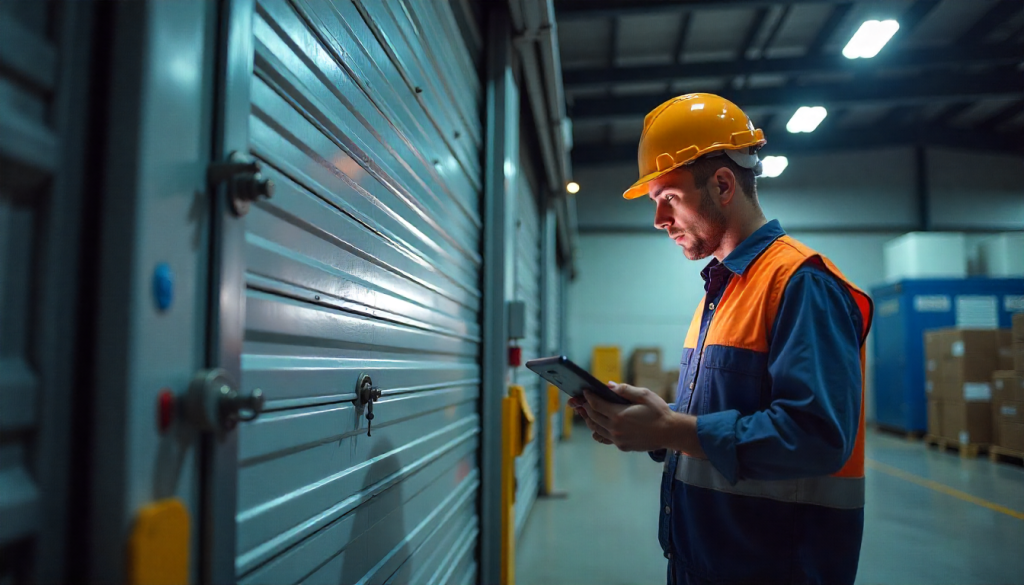
Steel roller doors are the workhorse of commercial garage door systems, and there’s good reason they’re everywhere you look in industrial areas. The construction is actually pretty straightforward, which is part of what makes them so reliable.
The door itself is a curtain made of interlocking galvanized steel slats, typically 0.8mm to 1.2mm gauge depending on the application. These slats lock into each other to create a continuous curtain that’s flexible enough to roll up but strong enough to handle daily use. At the bottom, you’ve got a reinforced bottom rail with a rubber seal that keeps out weather and debris.
The curtain runs up and down in guide rail channels—usually steel or aluminum—that keep everything aligned. When the door opens, the curtain winds around a barrel or drum system mounted above the opening. This design is compact, which is why roller doors are perfect when you need to maximize headroom clearance.
For Sutherland Shire locations, powder coating isn’t optional—it’s your first line of defense against coastal corrosion. The galvanized coating protects the base steel, but add powder coating on top and you’re looking at 15-20 years of service instead of 8-10. Wind lock systems are another must-have for coastal installations. These mechanisms lock the door into the guide rails when it’s closed, preventing wind from catching underneath and ripping the door out.
Every commercial roller door should have a manual chain override or emergency release mechanism. Trust me, you don’t want to be stuck with three delivery trucks waiting outside because the power went out and you can’t manually open your door.
Reliability Ratings and Real-World Performance
Let’s talk numbers. A standard commercial-grade steel roller door has a cycle rating of 25,000 to 50,000 cycles. With proper maintenance, you’re looking at 15-20 years of service life. That’s assuming you’re operating it 20 times a day—which is typical for most warehouses and industrial operations.
Here’s what actually fails on roller doors, in order of frequency:
Springs are always the first to go. They typically give out somewhere between 10,000 and 25,000 cycles. You’ll know it’s coming when the door starts operating slower or making different sounds. This is why annual spring tension checks are so important—catching spring fatigue early means you schedule the replacement instead of dealing with an emergency at 6 AM on a Monday.
Guide rail wear happens from repeated friction of the curtain sliding up and down. Bi-annual inspections catch this before it becomes a problem. Sometimes you just need to clean and lubricate, other times you’re looking at rail replacement.
Bottom seals deteriorate from UV exposure and constant contact with the ground. In Sutherland Shire’s climate, plan on replacing these every 5-7 years. It’s cheap and easy compared to other repairs.
Motor burnout on motorized systems usually happens when the motor is undersized for the door weight, or when the door isn’t properly balanced. Choose the right motor from the start and maintain proper balance, and you’ll get 15 years from your opener.
Barrel bearing wear is gradual but predictable. These bearings support the entire weight of the door, so they’re under constant stress. Quality bearings last 10-15 years; cheap ones might give you 5-7.
The good news? Repair costs on roller doors are typically lower than sectional doors because the mechanism is simpler. Parts are standardized, so availability is excellent. When you need a spring or a motor, we usually have it on the truck or can get it same-day.
Maintenance requirements are straightforward:
- Quarterly lubrication of all moving parts (15 minutes)
- Bi-annual guide rail inspection and cleaning (30 minutes)
- Annual professional spring tension check ($150-200)
- Track alignment verification as needed
- Slat condition assessment (looking for dents or damage)
Best Applications for Steel Roller Doors
Steel roller doors excel in specific applications, and knowing when they’re the right choice saves you money while getting maximum reliability.
Warehouse loading bays are the most common application, and for good reason. The door handles heavy daily use, provides excellent security, and doesn’t require climate control features. If you’re moving inventory in and out all day, this is your door.
Storage facilities and self-storage units use roller doors almost exclusively. They’re cost-effective, secure, and when you’re installing dozens or hundreds of units, the savings add up without sacrificing reliability.
Light industrial operations benefit from the security and simplicity. Manufacturing facilities, workshops, distribution centers—if you’re not worried about temperature control, roller doors deliver reliable service at the best price point.
Retail back-of-house access works great with roller doors. Customer never see it, security is excellent, and maintenance costs stay low.
Here’s the honest truth: roller doors are ideal when insulation isn’t a priority. If you’re in a climate-controlled environment, you’ll want to look at sectional doors instead. But for unheated warehouses, outdoor-temperature workshops, or any space where you’re not running HVAC, roller doors are hard to beat.
High-security applications favor roller doors because they’re difficult to force open. The continuous steel curtain in guide rails provides better security than sectional doors with their panel-to-panel joints. Add a good locking system and wind locks, and you’ve got excellent physical security.
Situations requiring maximum headroom clearance benefit from roller doors because the door retracts completely into the barrel system above the opening. With sectional doors, you lose ceiling space to the track system.
Fire-rated versions are available for specific applications where building codes require fire separation. These doors are tested and certified to contain fire for specific time periods.
Limitations and Considerations
Look, roller doors aren’t perfect for every situation. You need to know the limitations before you buy.
Insulation performance is limited. Even the best roller doors only achieve R-values of 0.5 to 1.5. If you’re trying to maintain temperature in a warehouse—whether keeping it cool in summer or warm in winter—you’re going to waste money on energy costs. For climate-controlled environments, sectional doors make more sense despite the higher upfront cost.
Noise levels during operation are noticeable. You’ve got metal-on-metal contact as the slats move through the guide rails. It’s not horrible, but it’s definitely louder than a belt-driven sectional door. If you’ve got offices adjacent to your warehouse, or you’re in a multi-tenant building, this matters.
Aesthetic limitations are real. Roller doors have an industrial appearance that works fine for warehouses but looks out of place on customer-facing retail operations or upscale facilities. If appearance matters to your business image, you’ll want sectional doors with architectural options.
Manual override can be challenging on large doors. When the power’s out and you need to manually open a 5m x 5m roller door, you’re going to need some muscle. The chain override works, but it’s not easy. Emergency access planning should account for this.
Wind load ratings vary significantly by model. Not all roller doors are engineered for coastal wind conditions. Cheap roller doors installed in Cronulla or Bundeena can fail catastrophically during severe storms. You need to specify wind-rated doors for Sutherland Shire coastal locations—it costs more upfront but prevents expensive emergency repairs (and potential liability issues).
Slat denting is possible with roller doors, though it doesn’t usually affect function. A forklift backing into the door might dent a few slats, but the door will still operate. Still, if appearance matters, this is a consideration.
Salt air corrosion accelerates without proper coating. Standard galvanizing alone won’t cut it in coastal Sutherland Shire. You need premium powder coating or you’ll see rust within 2-3 years. This adds to the upfront cost but is absolutely necessary for coastal installations.
Less suitable for customer-facing retail environments where the door is visible to customers. The industrial look doesn’t match the aesthetic most retail operations want to project.
Steel Roller Door Specs by Size:
| Door Size | Approx Weight | Motor Required | Cycle Rating | Cost Range |
| 3m x 3m | 80-100kg | 1/2 HP | 30,000-50,000 | $2,500-$4,000 |
| 5m x 4m | 180-220kg | 3/4 – 1 HP | 25,000-40,000 | $5,000-$8,000 |
| 6m x 5m | 280-350kg | 1 – 1.5 HP | 20,000-35,000 | $8,000-$12,000 |
Sectional Doors: When Insulation and Aesthetics Matter
While steel roller doors offer excellent value and reliability for industrial applications, many businesses require the enhanced insulation and aesthetic appeal that only sectional doors provide. Let’s explore when investing in sectional technology makes the most sense.
Engineering Advantages of Sectional Design
Sectional doors are engineered differently than roller doors, and that difference matters for certain applications. Instead of a continuous steel curtain, sectional doors are made of individual panels—typically 500mm to 600mm wide—that connect via hinges. Each panel consists of steel skins on both the front and back with polyurethane foam core sandwiched between.
Panel thickness ranges from 40mm for lighter commercial applications to 100mm for heavy industrial installations. That foam core isn’t just for insulation—it adds structural strength to each panel too.
The track system is where sectional doors really differ from rollers. You’ve got vertical tracks on either side that transition to horizontal ceiling tracks. The door doesn’t roll up into a barrel—it retracts back along your ceiling. This means the door saves space without protruding outside your building when it’s open, which is perfect for properties with limited clearance outside.
The hinge system that connects panels is what allows the door to flex through that curve from vertical to horizontal. Quality hinges use steel pins that can handle thousands of cycles. Cheap hinges with soft metal pins wear out fast, causing the panels to misalign and bind in the tracks.
Counterbalance spring mechanisms do the heavy lifting—literally. Torsion springs mounted above the door or extension springs at the sides counterbalance the door’s weight so the motor isn’t straining every time it opens. Properly sized springs are absolutely critical for reliability.
The bottom seal and weather stripping between each panel create a much tighter seal than roller doors achieve. This is why sectional doors are better for climate-controlled spaces—you’re not losing conditioned air through gaps.
One feature that business owners love: you can incorporate windows or vision panels in sectional doors for natural light. Try that with a roller door and you’re compromising the structural integrity of the curtain.
The architectural flexibility is huge too. Sectional doors come in a wide range of finishes, colors, and panel designs. If your door is customer-facing, sectional doors look professional instead of purely industrial.
Insulation Performance and Energy Efficiency
This is where sectional doors justify their higher price tag. R-values range from 2.5 to 4.5—that’s 3-4 times better insulation than even the best roller doors.
What does that mean in real dollars? For climate-controlled facilities, you’re typically looking at 15-25% reduction in heating and cooling costs for the garage area. Run those numbers over 10 years and the higher upfront cost of the sectional door pays for itself.
A warehouse in Kirrawee that we service switched from a worn-out roller door to an insulated sectional door with R-4.5 foam core. They were running a cold storage operation and hemorrhaging money on refrigeration costs. After the upgrade, their energy bills dropped by 22%—that’s $8,400 per year in savings. The door paid for itself in 4.2 years just from energy savings, not counting the improved temperature stability for their inventory.
Temperature stability benefits extend beyond just energy costs:
Food storage and preparation facilities need stable temps to maintain health department standards and prevent spoilage. Sectional doors help you hold those tight temperature ranges.
Pharmaceutical storage requires precise climate control. Temperature fluctuations from a poorly insulated door can compromise inventory worth tens of thousands of dollars.
Climate-sensitive inventory of any kind—whether it’s electronics, chemicals, or premium goods—benefits from the stable environment sectional doors provide.
Workshops requiring comfortable working conditions see productivity improvements when you’re not dealing with extreme heat or cold coming through a poorly insulated door. Your employees will appreciate it during Sydney’s 45°C summer days and 8°C winter mornings.
Condensation prevention in cold storage applications is another major benefit. The insulation keeps the interior door surface warmer, preventing condensation that leads to rust, ice buildup, and slippery floors.
The acoustic insulation bonus might not seem important until you’re in a multi-tenant property. Sectional doors reduce noise transmission by 30-40% compared to roller doors. If you’re running noisy operations and have neighbors, this matters.
Reliability Factors Specific to Sectional Doors
Sectional doors typically outlast roller doors—we’re talking 20-25 year lifespan with proper maintenance. Cycle ratings range from 30,000 cycles for standard systems up to 100,000+ cycles for premium spring systems and heavy-duty construction.
Critical maintenance points for sectional doors include:
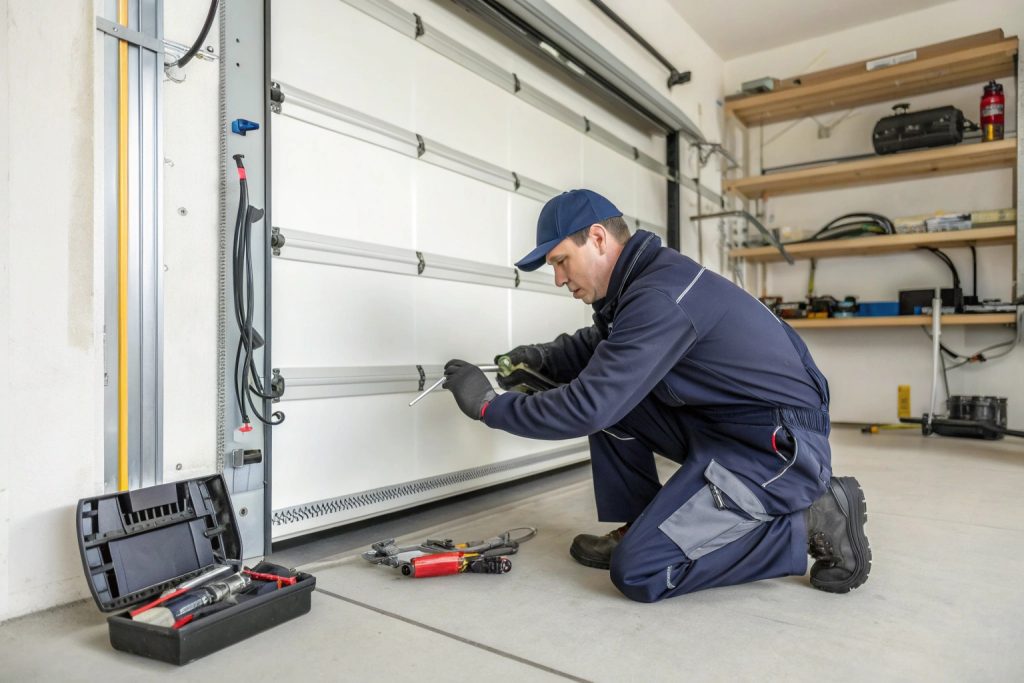
Spring tension monitoring is non-negotiable. These are high-tension springs that store significant energy. Only professionals should adjust or replace them—DIY spring work has resulted in serious injuries and even deaths. We check spring tension annually and replace them proactively when they’re nearing end of life, typically around 10,000-25,000 cycles depending on the spring quality.
Panel alignment checks prevent binding and uneven wear. Misaligned panels cause the door to bind in the tracks, which strains the motor and accelerates wear. We verify alignment bi-annually or whenever the door starts showing operating issues.
Track condition matters more on sectional doors than roller doors. Debris in tracks causes rollers to bind. Lubrication keeps everything moving smoothly. Quarterly maintenance includes track cleaning and lubrication.
Hinge pin inspection catches wear before panels start misaligning. Worn hinge pins let panels sag, which throws off the whole door’s alignment. We replace these proactively during annual service.
Roller bearing condition directly affects motor strain. Worn rollers increase friction, which makes the motor work harder and shortens its life. Quality sealed bearings last 10-15 years; cheap open bearings might give you 5-7.
Weather seal replacement is typically needed every 5-7 years. In Sutherland Shire’s harsh UV environment, it might be closer to 5 years. This is a relatively inexpensive maintenance item that has huge impact on insulation performance.
The weather seal effectiveness on sectional doors is superior to roller doors because you’ve got seals on all four sides plus between each panel. When everything’s in good condition, you get an essentially airtight seal.
One big reliability advantage: panel replacement capability. If a forklift damages one panel on a sectional door, you replace that panel. With a roller door, you might need to replace the entire curtain depending on damage location. This modular repairability extends the door’s overall lifespan.
The tracks on sectional doors are less exposed to elements than roller door guides, which helps in coastal environments. The horizontal ceiling tracks are inside your building, protected from salt air and weather.
The mechanism is more complex than roller doors, which means slightly higher maintenance requirements and costs. But the trade-off is worth it for applications where insulation and longevity matter.
Ideal Commercial Applications
Sectional doors make sense for specific applications where their benefits justify the higher cost:
Automotive service centers and dealerships benefit from both the aesthetic appeal and the acoustic insulation. Your customers see professional-looking doors, and the reduced noise improves their experience while waiting.
Temperature-controlled warehouses recoup the extra cost through energy savings. Whether you’re keeping inventory cool or warm, insulation pays dividends every month.
Pharmaceutical storage facilities where climate stability is regulatory requirement need the performance that sectional doors deliver. You can’t risk temperature fluctuations compromising inventory.
Food service operations dealing with health department requirements appreciate the superior sealing and easy-to-clean surfaces of sectional doors.
Customer-facing retail operations use sectional doors to maintain professional appearance. Showrooms, car dealerships, high-end retail—these businesses need doors that look as good as they perform.
Premium office/warehouse combinations where the door might be visible from office areas benefit from the aesthetic options and noise reduction.
Medical facilities requiring climate control rely on sectional doors to maintain the stable environment necessary for patient care and equipment.
Any application where energy efficiency justifies the investment should consider sectional doors. Run the numbers on your energy costs and see what a 15-25% reduction means over 10 years.
Businesses seeking professional aesthetic appearance understand that your facility’s appearance affects customer perception. High-quality sectional doors project success and attention to detail.
Operations with moderate to heavy daily use get excellent longevity from properly specified sectional doors. The higher cycle ratings justify the investment for businesses operating 30+ times per day.
Applications requiring quiet operation need sectional doors with belt drive or direct drive operators. Residential-style neighborhood locations, multi-tenant buildings, or any situation where noise complaints are a concern.
Cost vs. Longevity Analysis
Let’s be honest about the numbers. Sectional doors cost 40-70% more than equivalent roller doors upfront. But that’s not the complete picture.
A 5m x 4m roller door might cost $5,000-$6,000 installed. The equivalent sectional door runs $8,000-$10,000. So you’re paying $3,000-$4,000 more initially.
But here’s where it gets interesting:
Longer lifespan means you’re amortizing the cost over more years. Roller door lasting 15 years vs. sectional door lasting 25 years—that’s 66% longer service life.
Reduced energy costs for climate-controlled facilities can save $500-$2,000 per year. Over the door’s lifespan, that’s $12,500-$50,000 in savings. The door pays for itself and then some.
Lower replacement frequency means you’re not dealing with another installation project as soon. The time and disruption saved has value that’s hard to quantify but very real.
Panel replacement extends door life beyond 25 years. We’ve got sectional doors we service that are 30+ years old because the owners replace damaged or worn panels instead of the whole door.
Higher resale value or property appeal might not be the first thing you think about, but quality infrastructure adds to property value. If you’re selling or leasing, professional doors matter.
Reduced maintenance frequency compared to roller doors means fewer service calls over the door’s lifetime. Sectional doors need annual professional service; roller doors benefit from bi-annual service in our coastal environment.
Premium appearance can attract higher-quality tenants or customers. This is harder to quantify but matters for certain businesses.
Let’s look at a 20-year total cost of ownership comparison:
Sectional Door:
- Initial cost: $9,000
- Maintenance: $3,000 (annual service at $150 x 20 years)
- Energy savings: -$15,000 (saving $750/year for climate-controlled facility)
- Net 20-year cost: -$3,000 (you actually save money)
Roller Door:
- Initial cost: $5,500
- Replacement at year 15: $5,500 (doors wear out faster)
- Maintenance: $4,000 (more frequent service needed)
- Energy savings: $0 (no insulation benefit)
- Net 20-year cost: $15,000
This example shows why smart business owners look beyond the sticker price. For the right application, sectional doors save money over their lifetime while delivering better performance.
Obviously these numbers vary based on your specific situation—door size, usage patterns, energy costs, maintenance practices. But the principle holds: higher quality upfront often costs less long-term.
High-Speed Doors: Specialized Industrial Applications
For most Sutherland Shire businesses, sectional doors represent the optimal balance of reliability and features. However, high-traffic operations with extreme cycle requirements need an entirely different solution.
Technology and Performance Specifications
High-speed doors operate at speeds that would terrify you if you weren’t expecting it. Opening speeds range from 1.0 to 2.5 meters per second—that’s 5-10 times faster than standard doors. Closing speeds run 0.8 to 2.0 meters per second. To put this in perspective, a standard sectional door takes 12-15 seconds to open. A high-speed door does it in 3-4 seconds.
This speed isn’t just for show—it’s solving specific operational problems. Every second a door stays open, you’re losing conditioned air, letting in contaminants, or creating a traffic bottleneck. High-speed doors minimize open-door time dramatically.
The self-repairing mechanism is genius engineering. If something impacts the door and knocks it out of the guide tracks—which happens in high-traffic environments—the door automatically re-inserts itself into the guides and keeps operating. No emergency service call, no downtime. This feature alone prevents thousands in lost productivity over the door’s life.
Sensor integration makes these doors smart. Safety beams, motion detectors, loop detectors in the floor—the door knows when vehicles or people are approaching and opens automatically. You’re not waiting for someone to push a button or fumble with a remote. Forklifts drive straight through without stopping.
Programmable logic controllers (PLCs) manage all the automation. You can program different operating modes for different times of day, adjust speeds based on traffic patterns, integrate with your building management system—the flexibility is impressive.
Variable frequency drives (VFDs) control the motor for smooth acceleration and deceleration. No jerky starts and stops that stress components. This smoothness extends component life significantly.
The door itself uses either fabric curtains—usually PVC or reinforced vinyl—or metal curtains made of aluminum slats. Fabric is more common because it’s lighter and faster. Insulated fabric options are available for temperature-controlled environments.
Wind-resistant designs handle the kind of wind loads you get in Sutherland Shire coastal locations. The engineering required to make something this fast also withstand 80+ km/h winds is impressive.
Safety features exceed standard door requirements by a wide margin. Multiple sensors, soft edges that reverse on contact, emergency stop buttons—these doors are engineered for high-traffic environments where safety is paramount.
Integration with warehouse management systems lets the doors communicate with your other equipment. Conveyors, sorting systems, security—everything can work together.
Remote monitoring and diagnostic capabilities mean the door reports its own health. You get alerts before problems become failures. Predictive maintenance becomes possible instead of just preventative.
Reliability in High-Cycle Environments
High-speed doors are designed specifically for extreme use. Cycle ratings of 500,000 to 1,000,000+ cycles aren’t marketing hype—these doors genuinely handle 10-20 times the cycles of standard commercial doors.
Think about what that means for a distribution center operating 24/7 with 100+ daily cycles. A standard commercial door rated for 50,000 cycles gives you maybe 500 days of operation before you’re pushing the limits. A high-speed door rated for 500,000 cycles gives you 5,000 days—13+ years at that usage rate.
Predictive maintenance capabilities change the game. Sensors monitor operating patterns and detect anomalies before failure occurs. The door tells you “spring tension is decreasing, schedule replacement in 30 days” instead of failing unexpectedly at 3 AM on a Saturday.
Real-time diagnostics alert maintenance staff to potential issues. Temperature sensors on motors, cycle counters, speed monitors—all this data gets logged and analyzed. Problems get caught early when they’re easy and cheap to fix.
Component replacement schedules are clearly defined because manufacturers have extensive testing data. You know when to replace bearings, when to service the motor, when to inspect the guide rails. No guesswork.
Uptime statistics of 99.5%+ are achievable in properly maintained installations. That’s only 1-2 days of downtime per year, and most of that is scheduled maintenance. For businesses where door functionality is operational, this reliability is game-changing.
The self-repairing feature minimizes downtime from impacts. A forklift clips the door? It resets itself automatically. With a standard door, that same impact might mean 4-8 hours of emergency service and lost productivity.
Modular design allows quick component replacement. Motors, control boards, sensors—everything is designed for fast swapping. Mean time to repair (MTTR) typically runs under 2 hours for most issues.
Parts availability is critical, and this is where manufacturer support agreements matter. Make sure your supplier maintains local stock of common parts. Waiting 3 days for a control board from overseas defeats the purpose of a high-reliability garage door.
Extended warranties are common because manufacturers are confident in their product. 5-7 year comprehensive warranties on high-speed doors aren’t unusual, whereas standard commercial doors might offer 2-3 years.
When High-Speed Doors Make Sense
These doors are expensive, so you need the right application to justify the investment. Here’s when they make sense:
High-traffic loading docks with 50+ cycles per day absolutely benefit from high-speed doors. The productivity gains and reduced door wear justify the investment quickly.
Distribution centers with rapid throughput requirements need doors that don’t create bottlenecks. When you’re processing hundreds of trucks per day, every second counts.
Temperature-controlled environments recoup the investment through energy savings. Minimizing open-door time means less conditioned air loss. Cold storage facilities save thousands annually by reducing the time refrigerated air escapes.
Clean room facilities for pharmaceutical or electronics manufacturing can’t have extended open-door periods letting in contaminants. High-speed doors maintain the controlled environment.
Automated warehouse systems with continuous forklift traffic need doors that keep pace with operations. Manual controls create inefficiency.
Cold storage operations are prime candidates. The faster the door operates, the less energy you lose. In facilities maintaining -20°C or colder, energy losses through standard doors are massive. High-speed doors can reduce energy costs by 50-75%.
Food processing facilities benefit from both the hygiene aspects (less open-door time means less cross-contamination risk) and the temperature control.
Car washes need doors that cycle hundreds of times per day. High-speed doors are standard in modern automated car wash facilities.
Airport facilities and hangars use high-speed doors for their ability to handle extreme cycle counts and large opening sizes.
Any operation where the time-is-money principle applies strongly should calculate whether high-speed doors justify themselves through operational efficiency gains.
Facilities with significant energy costs from conditioned air loss often find high-speed doors pay for themselves purely through energy savings. We’re talking facilities spending $50,000+ annually on HVAC costs.
Investment and ROI Considerations
Let’s talk money. High-speed doors cost 3-5 times what standard commercial doors cost. A standard sectional door might run $10,000. The equivalent high-speed door could be $35,000-$50,000.
That’s a tough pill to swallow until you run the numbers on what that door delivers:
Operational efficiency gains from reduced cycle time add up. If your operation processes 80 trucks daily and each truck saves 30 seconds in door cycle time, you’re saving 40 minutes of daily productivity. Over a year, that’s nearly 250 hours. What’s your labor cost per hour?
Energy savings from reduced open-door time run 50-75% for cold storage applications. A facility spending $20,000 annually on energy losses through a standard door might spend only $5,000-$10,000 with a high-speed door. That’s $10,000-$15,000 annual savings. The door pays for itself in 3-4 years just on energy costs.
Labor cost reduction through automation means drivers don’t stop, no one’s running to push buttons, workflow stays smooth. Calculate the time savings across your daily operations.
Reduced damage costs from the self-repairing feature prevent expensive emergency repairs. One impact that would cost $2,000 to repair on a standard door costs nothing on a high-speed door because it self-repairs automatically.
Extended lifespan in high-cycle applications means you’re not replacing doors every 8-10 years. A high-speed door might last 15-20 years in an application that would destroy a standard door in 5 years.
Minimized downtime in critical operations has value that’s hard to quantify. What’s it worth to your business to have 99.5% uptime instead of 95% uptime? That 4.5% difference could be thousands in lost revenue.
A typical ROI period of 2-5 years for high-volume operations is what we see in practice. Operations with 50+ daily cycles typically hit break-even within 3 years.
The honest truth? High-speed doors aren’t cost-effective for low-cycle applications under 20 cycles per day. If you’re only opening the door 15 times daily, stick with a quality sectional door and save the money.
Real-World Example: Kirrawee Distribution Center
A large distribution facility we service operates 100+ cycles daily, 6 days per week. After installing high-speed doors 5+ years ago, they’ve completed over 200,000 cycles without a single major failure. Their energy costs dropped $12,000 annually, and truck loading efficiency improved by 15% because drivers aren’t waiting for slow doors. Total maintenance costs? Only scheduled service—no emergency repairs ever. The doors paid for themselves in 3.2 years and have been pure profit since.
Material Comparison: Steel vs Aluminum vs Composite
Understanding the operating mechanisms is crucial, but the material you choose forms the foundation of your door’s reliability, especially in Sutherland Shire’s challenging coastal environment.

Steel (Galvanized and Powder-Coated)
Steel is the workhorse material of commercial garage doors, and there’s good reason it dominates the market. But not all steel is created equal, especially in coastal environments.
Corrosion resistance depends entirely on the protective coatings. Galvanized coating—a zinc layer applied to the base steel—provides the first line of defense. This is critical for Sutherland Shire’s coastal environment where salt air attacks bare steel relentlessly. But galvanizing alone isn’t enough.
Powder coating adds an additional protection layer that dramatically extends lifespan. We’re talking 15-25 years with proper galvanizing and powder coating versus 8-10 years with just galvanizing. In coastal applications within 5km of the ocean, premium powder coating isn’t optional—it’s required.
Coastal applications require the highest-grade coatings available. We’ve seen standard-coated steel doors show rust spots within 18 months in Cronulla. Upgrade to premium coastal-grade powder coating and that same door stays rust-free for 15 years.
Regular inspection prevents rust progression. Catch a small chip in the coating and touch it up immediately, and you’ve prevented a rust problem. Ignore it and that tiny chip becomes a spreading rust spot within months in our salt air environment.
Structural strength is where steel shines. Excellent wind load performance makes steel the go-to choice for NSW coastal areas where cyclonic winds happen. Steel resists impact damage better than aluminum—a forklift backing into a steel door might dent it, but an aluminum door could puncture.
For high-security applications, steel is the clear choice. The higher density and strength make forced entry significantly harder.
Gauge options range from 0.8mm for light-duty applications to 1.5mm+ for heavy-duty installations. The heavier the gauge, the more durable the door, but also the heavier the weight and higher the cost.
Weight considerations matter for operating systems. Steel doors are heavy—significantly heavier than aluminum equivalents. This means you need more robust opening systems, typically 1/2 HP to 1 HP motors for commercial applications. Spring systems must be properly sized or you’ll have premature failures.
Maintenance requirements are more intensive in coastal zones. Annual inspection for coating damage is minimum; we typically recommend 6-month inspection cycles for Sutherland Shire coastal businesses. Touch-up painting prevents rust spread—catch it early and a $50 touch-up prevents a $500 repair later.
Cost-wise, steel is the most economical option for commercial applications. You get excellent strength and reasonable longevity at the lowest price point. For many businesses, properly coated steel delivers the best value proposition.
Aluminum
Aluminum changes the equation, especially for Sutherland Shire coastal businesses.
Lightweight advantages are significant. Aluminum weighs 60-70% less than equivalent steel construction. This reduced weight means less strain on operating systems, which extends motor and spring lifespan. You can sometimes get away with smaller motors, which saves money upfront and on electricity costs.
Allows for larger door sizes without upgrading motors. A 5m x 5m aluminum door might work fine with a 3/4 HP motor, whereas the steel equivalent needs a 1 HP motor.
Smoother, quieter operation comes from the reduced weight. Less mass to move means less strain on every component.
Natural corrosion resistance is aluminum’s killer feature for coastal environments. Aluminum forms a protective oxide layer naturally—it doesn’t rust like steel. Salt air poses no significant threat. This is huge for Sutherland Shire businesses within a few kilometers of the coast.
In our coastal environment, aluminum doors can outlast steel doors by 5-10 years purely because they don’t have corrosion issues. We’re seeing aluminum doors hitting 20-30 years in coastal installations whereas steel doors struggle to make 15 years without significant rust issues.
Minimal maintenance required—no rust touch-ups, no repainting to prevent corrosion spread, no constant battle against salt air. Annual inspections and basic lubrication, that’s about it.
Aesthetic options are impressive. Anodized finishes provide enhanced corrosion protection and a premium appearance. Wide color variety through powder coating. Contemporary appearance works great for customer-facing applications. The clean, professional look is popular in automotive dealerships, retail showrooms, and upscale facilities.
Dent susceptibility is aluminum’s main weakness. It’s softer metal that dents more easily than steel. A forklift impact that would dent steel might puncture aluminum. Cosmetic damage doesn’t usually affect function—a dented aluminum door still operates fine—but if appearance matters, this is a consideration.
Consider protective bollards in high-traffic areas with forklifts and heavy equipment. Preventing impacts is smarter than dealing with dented doors.
Lifespan expectations of 20-30 years in coastal areas beat steel by a significant margin. In Cronulla, Bundeena, Kurnell—anywhere with direct salt air exposure—aluminum lasts longer despite being softer.
Premium pricing of 30-50% higher cost than steel is the trade-off. But for coastal businesses, calculate the true cost including maintenance and lifespan. Aluminum might actually cost less over 20 years when you factor in reduced maintenance and extended lifespan.
Composite Materials
Composites are the new kid on the block, and while they’re promising, we’re still building long-term track records.
Emerging technology means composite doors are relatively new to commercial applications. The technology is combining benefits of multiple materials—typically fiberglass reinforcement in resin matrices, sometimes with other materials blended in. Ongoing development and improvement continues as manufacturers refine formulas and construction methods.
Fiberglass-reinforced panels deliver an interesting combination. Lightweight yet strong. Excellent corrosion resistance—even better than aluminum in some cases. Good insulation properties built into the material itself. Impact resistant, though not as strong as steel.
Extreme weather resistance is where composites shine. UV resistant with no fading or degradation—important in our harsh Australian sun. Temperature extremes don’t affect performance the way they stress metal doors. No expansion and contraction issues causing alignment problems over time. The coastal environment is actually an ideal application for composites.
Limited long-term performance data is the caveat. These doors have less than 10 years of widespread commercial use. We don’t have the 20-year track records we have with steel and aluminum. Manufacturer warranties become especially important here—you want companies standing behind their products long-term.
Consider composites for non-critical applications initially while the long-term data develops. Let the early adopters prove the lifespan before betting your mission-critical loading dock on unproven technology.
Specialized application suitability makes composites interesting for specific situations. Harsh coastal environments where even aluminum shows some degradation over decades. Extreme temperature applications where metal expansion/contraction is problematic. Situations where weight is a critical concern. Premium aesthetic requirements where the unique appearance of composites is desirable.
Cost runs similar to or higher than aluminum. You’re paying for cutting-edge material technology. As composites become more common, prices should come down, but right now they command premium pricing.
Material Selection Decision Matrix
Budget constraints matter. If you’re working with limited capital:
- Steel: Most economical upfront cost
- Aluminum: Premium pricing but better long-term value for coastal locations
- Composite: Highest cost, best reserved for specific applications where other materials won’t work
Environmental exposure drives material choice:
- Coastal locations (Cronulla, Bundeena, Kurnell): Aluminum or composite strongly preferred. Steel only with premium coastal-grade coatings and commitment to 6-month maintenance cycles.
- Inland locations (Menai, Lucas Heights): Steel acceptable with good powder coating. Lower salt air exposure means steel performs better.
- Industrial areas with high pollution: Aluminum or premium steel coatings. Chemical exposure accelerates deterioration of standard coatings.
Aesthetic requirements influence material choice:
- Customer-facing applications: Aluminum or sectional steel with quality finish. Professional appearance matters.
- Industrial/warehouse back-of-house: Standard steel adequate. Function over form.
- Retail/showroom: Aluminum preferred. The contemporary appearance matches upscale retail aesthetics.
Security needs vary by application:
- High security: Heavy-gauge steel. Superior strength against forced entry.
- Standard security: Any material adequate with proper locking systems.
- Impact resistance: Steel preferred for environments with heavy equipment traffic.
Maintenance capacity affects material choice:
- Limited maintenance staff: Aluminum reduces maintenance burden. Less frequent inspections, no rust touch-ups.
- Regular maintenance program: Any material suitable if you’re committed to proper care.
- Coastal locations: Aluminum dramatically reduces maintenance requirements compared to steel.
Material Comparison Table:
| Factor | Steel (Galvanized + Powder) | Aluminum | Composite |
| Corrosion Resistance (coastal) | ★★★☆☆ (requires maintenance) | ★★★★★ (excellent) | ★★★★★ (excellent) |
| Structural Strength | ★★★★★ (excellent) | ★★★☆☆ (good) | ★★★★☆ (very good) |
| Weight | Heavy (requires robust motors) | Light (60-70% lighter) | Light (similar to aluminum) |
| Cost | $ (most economical) | $$ (30-50% premium) | $$$ (highest) |
| Lifespan (coastal) | 15-20 years | 20-30 years | Unknown (10+ so far) |
| Maintenance | High (coastal) / Moderate (inland) | Low (minimal upkeep) | Low (assumed, limited data) |
| Best Applications | Inland industrial, budget-conscious, high-security | Coastal locations, customer-facing, low-maintenance | Extreme environments, premium installations |
Door Size and Weight Considerations for Reliability
Now that we’ve examined the materials that ensure longevity, it’s essential to understand how door size and weight dramatically impact long-term reliability.
How Size Impacts Long-Term Reliability
Here’s something most people don’t realize: stress on operating systems increases exponentially, not linearly, as doors get larger. A 5m door doesn’t experience twice the stress of a 2.5m door—it experiences roughly four times the stress. The relationship is geometric, not arithmetic.
This means spring tension requirements increase dramatically. A small door might need a single torsion spring; a large door needs multiple high-tension springs. Motor duty cycle becomes a critical factor—you can’t use a residential-grade opener on a 6m commercial door and expect reliability.
Track structural requirements intensify with size. Larger doors need heavier-gauge tracks, closer bracket spacing, more robust hardware throughout. Skimp on structural requirements and you’re looking at premature failures.
Wind load calculations become critical for Sutherland Shire coastal locations. Larger surface area means greater wind force—a 6m x 5m door presents 30 square meters of surface to wind loads. During severe storms with 80+ km/h winds, the forces are massive.
Australian Standard AS 4420.1 wind load ratings are mandatory for commercial installations. Site-specific engineering may be required for exposed coastal locations with large doors. The importance increases exponentially with door size.
Consider prevailing wind direction and exposure. A door facing south toward the coast experiences different wind loads than one facing north. Proper engineering accounts for these site-specific factors.
Structural support requirements can’t be overlooked. The header beam above the door must support the door’s weight plus operating loads. Larger doors require beefier beams—sometimes requiring structural modifications to the building itself.
Wall anchor spacing and strength matter more as doors get larger. Foundation adequacy becomes a concern for very large doors—if your foundation can’t support the concentrated loads, you’ve got problems.
Track support bracket frequency increases with door size. Smaller doors might need brackets every 1.5m; large doors need them every meter or closer.
Proper installation becomes absolutely critical for reliability. There’s less room for error on large doors—installation tolerances tighten as size increases.
Cycle life variations by size are real and measurable:
- Smaller doors (up to 3m): Typically achieve full rated cycle life with no issues. Everything’s operating well within design limits.
- Medium doors (3-5m): May experience 10-15% cycle life reduction unless you specify premium components. Standard components are working harder.
- Large doors (5m+): Can experience 20-30% cycle life reduction without proper engineering and premium components. You absolutely need to oversize everything.
Premium components become essential for larger installations. Don’t try to save money on springs, motors, or tracks for big doors—you’ll pay for it in premature failures and emergency repairs.
Weight Distribution and Opening Systems
Counterbalance spring sizing must be precisely calculated for door weight. This isn’t guesswork territory—it’s engineering.
Undersized springs mean the motor strains against the door’s weight every cycle. Motor burnout becomes inevitable, usually within 2-3 years instead of the 15-year lifespan you should get. Spring life also suffers when they’re handling more weight than designed for.
Oversized springs create different problems. The door becomes difficult to stop smoothly—it wants to fly up when opening, slam down when closing. Safety concerns arise, and the motor works hard controlling the door instead of just moving it. Not as bad as undersizing, but still problematic.
Professional spring selection is critical. We calculate spring requirements based on door weight, size, and operating speed. Getting this right determines whether your door lasts 15 years or fails in 3.
Spring life is inversely related to door weight. Heavier doors wear springs faster. A properly sized spring on a heavy door might last 15,000 cycles; the same spring on a lighter door could hit 30,000 cycles. This is physics, not negotiable.
Motor power requirements scale with door size and weight:
- 1/2 HP: Suitable for doors up to 3m x 3m, light commercial use. Total weight under 100kg.
- 3/4 HP: Standard for 4m x 4m doors, moderate use. Weights 100-180kg.
- 1 HP: Required for 5m+ doors or heavy-duty applications. Weights 180-280kg.
- 1.5+ HP: Industrial applications, oversized doors. Weights over 280kg.
Duty cycle ratings matter as much as horsepower. A 1 HP residential motor isn’t the same as a 1 HP commercial motor. Residential motors are rated for intermittent use—a few cycles per hour with cooling periods. Commercial motors handle continuous use—back-to-back cycles all day long.
Undersizing the motor is penny-wise and pound-foolish. You save $200 upfront and spend $800 replacing the burned-out motor 18 months later.
Track gauge and structural integrity increase with door size. Track thickness must increase—light-duty track on a heavy door bends and fails. Standard duty versus heavy-duty track makes huge difference in longevity.
Support bracket spacing gets closer for heavier doors. A light door’s track might need brackets every 2 meters; a heavy door needs them every meter. This isn’t optional—inadequate support causes track sag and alignment problems.
Track alignment precision becomes more critical as doors get larger. A 1mm misalignment on a small door? Probably fine. Same 1mm on a 6m door? You’ll have binding, uneven wear, and operational problems.
Safety factor calculations should guide all component selection. We specify all components rated 25-30% above actual requirements. This provides a longevity buffer that accounts for normal wear over time.
The safety factor is essential for reliability in commercial applications. Operating components at 70% of their rated capacity instead of 100% can literally double their lifespan.
Standard Commercial Sizes and Reliability Data
3m x 3m (standard single bay) is the sweet spot for reliability. This is the most reliable size category because everything’s operating well within design limits. Expected cycle life: 30,000-50,000+ cycles with standard commercial components.
Widest component availability—every manufacturer makes springs, motors, and parts for 3×3 doors. Easiest to service and maintain because parts are always in stock. Typical applications include storage units, small warehouses, retail back doors.
Cost ranges from $2,500-$5,000 installed depending on material and features. This size delivers the best value and most predictable performance.
5m x 4m (double bay) is the common warehouse and industrial size. Expected cycle life: 25,000-40,000 cycles. The larger size means components work harder, reducing cycle life slightly.
Requires heavier-duty components across the board—springs, tracks, motors, all need upgrading from residential-grade to true commercial-grade. More critical installation precision—alignment tolerances tighten.
Typical applications include loading docks, vehicle storage, workshops—anywhere you need to accommodate larger vehicles or equipment. Cost ranges from $5,000-$10,000 installed.
Custom oversized (6m+) doors are where engineering challenges increase exponentially. Expected cycle life: 20,000-35,000 cycles without premium components. Everything becomes custom or semi-custom.
Often requires custom fabrication instead of off-the-shelf components. Professional installation is absolutely essential—this isn’t DIY territory. May require specialty operators like industrial-grade chain drives or hydraulic systems.
Typical applications include aircraft hangars, large distribution centers, boat storage—specialized facilities with unusual requirements. Cost varies wildly from $10,000-$30,000+ installed depending on size and requirements.
Ultra-light vs. heavy-duty construction within each size category:
- Light construction: Suitable for low-cycle, protected applications. Budget option.
- Standard construction: Most commercial applications. Good balance of cost and durability.
- Heavy-duty construction: High-cycle, high-traffic, or exposed locations. Worth the premium for demanding applications.
- Premium construction: Extreme duty, 24/7 operations. Maximum longevity for mission-critical applications.
Expert Tip: Why oversizing your opener extends door life—Operating your motor at 70% capacity versus 100% capacity can double the motor’s lifespan. The extra $200-300 for a larger motor pays for itself by preventing premature motor failure.
Operating Systems: Chain vs Belt vs Direct Drive
Size and weight considerations directly influence your choice of operating system—the mechanical heart of your commercial garage door.
Chain Drive Systems
Chain drives are the tried-and-true workhorses of commercial garage door operation. There’s 50+ years of proven track record here, and there’s a reason they’re still the most common choice for industrial applications.
Reliability profile is excellent. Expected lifespan runs 15-20 years with proper maintenance. The robust design handles heavy doors effectively without complaint. Simple mechanics mean fewer failure points—there’s not much to go wrong with a chain pulling a trolley along a rail.
Easy to diagnose and repair when issues do arise. Most technicians can troubleshoot chain drive problems quickly because the mechanics are straightforward. Parts are readily available nationwide—even in remote locations, getting a chain drive part rarely takes more than a day.
Noise levels are the trade-off. Metal-on-metal operation creates noticeable sound during operation. Sound levels typically hit 60-70 decibels during operation—about as loud as normal conversation or background music. Not deafening, but definitely noticeable.
Not ideal for noise-sensitive environments like multi-tenant buildings or facilities with adjacent offices. Can disturb quiet operations or customer-facing areas. If you’ve got offices sharing a wall with your warehouse, your office staff will hear every door cycle.
Maintenance requirements are straightforward but necessary. Regular lubrication is essential—we recommend quarterly for commercial applications. Chain tension adjustment needed periodically as the chain stretches with use. Sprocket wear inspection annually catches problems before the chain starts slipping.
Rust prevention matters in coastal environments. The chain is exposed metal that corrodes in salt air if not properly maintained. More maintenance-intensive than belt drives, but nothing complicated.
Cost-effectiveness is chain drive’s strong suit. Most economical opener option by far—often 30-40% less than belt drive equivalents. Excellent value for high-weight doors where belt drives struggle. Lower replacement cost if failure occurs makes the lifetime cost very competitive.
Parts are inexpensive and widely available. A replacement chain costs $50-100 vs. $150-250 for a replacement belt. When you factor in the lower upfront cost plus cheaper parts, chain drives deliver serious value.
Best applications for chain drives:
- Warehouses and distribution centers where noise isn’t a concern
- Industrial facilities with heavy machinery already creating ambient noise
- Storage facilities operating during business hours
- Back-of-house operations where customers don’t hear the door
- Any application where noise isn’t a critical factor
- Heavy doors requiring maximum pulling power
Belt Drive Systems
Belt drives solve the noise problem while maintaining good reliability.
Quieter operation is the primary selling point. Significantly quieter than chain drives—40-50 decibels instead of 60-70. That’s literally half the perceived noise level. Ideal for noise-sensitive environments where the door’s operation shouldn’t disturb people.
Multi-tenant buildings benefit dramatically from belt drives. Office/warehouse combinations where office staff work near the warehouse. Customer-facing operations where door noise affects customer experience. Rubber or polyurethane belt eliminates the metal-on-metal sound completely.
Lower maintenance requirements save time and money long-term. Less frequent lubrication needed—bi-annually instead of quarterly. No chain tension adjustments ever needed. Cleaner operation with no lubrication drip issues.
Longer intervals between service appointments reduce maintenance costs. Reduced maintenance labor over the door’s lifetime adds up to real savings.
Lifespan is comparable to chain drives—15-20 years expected. The belt itself may need replacement at the 10-15 year mark, which costs $150-250 plus labor. Otherwise, longevity is similar to chain systems with similar maintenance practices.
Weight limitations exist for belt drives. Not ideal for extremely heavy doors over 300kg—the belt can slip under heavy loads. Best for light to medium-weight doors where the quietness advantage matters most.
You can sometimes overcome weight limitations by oversizing the belt drive system, but at that point you’re paying premium prices for marginal performance. Better to use chain drive for heavy doors.
Premium pricing runs 20-40% higher than equivalent chain drives. But the price is justified by reduced noise, lower maintenance, and operational benefits in the right applications.
Calculate the ROI through maintenance savings and operational improvements. If noise matters to your business, the premium pays for itself quickly.
Best applications for belt drives:
- Retail facilities with customer presence
- Automotive service centers where customers wait nearby
- Office/warehouse combinations
- Multi-tenant properties where neighbors share walls
- Anywhere noise reduction is valued
- Medium-weight doors in moderate-use applications
Direct Drive (Jackshaft) Systems
Direct drive or jackshaft systems represent the most modern approach to door operation.
Modern technology advantages include the motor mounting directly to the wall beside the door instead of overhead. This eliminates the long drive shaft and associated components that can fail. Fewer moving parts means reduced failure points.
The compact, space-efficient design frees up overhead space. Modern electronics provide advanced features like soft start/stop, variable speed control, diagnostic capabilities.
Minimal moving parts is a huge reliability advantage. Direct connection to the torsion bar means no chain or belt to maintain. No overhead rail system eating up ceiling space. Reduced mechanical complexity means less to go wrong. Fewer components to fail or wear out over time.
Space-saving ceiling clearance benefits are critical for certain applications. Buildings with low headroom where standard openers won’t fit. Situations where you need to free up ceiling space for other uses—overhead cranes, ductwork, storage racks.
Allows for maximum door height in limited clearance situations. Popular in retrofit situations where you’re adding a door to an existing building with limited overhead space.
Longer lifespan potential comes from the simplified mechanics and better protection. Expected lifespan of 20-25 years—that’s 25-33% longer than chain or belt systems. Reduced wear from simplified mechanics. Premium motors are typically used.
The wall-mounted position provides better protection from elements compared to ceiling-mounted motors in dusty or dirty environments. Advanced electronics may require earlier replacement than mechanical components, but the base system lasts longer.
Higher upfront investment is the trade-off. 50-80% more expensive than chain drives—you’re paying $1,200-1,800 for a jackshaft system versus $600-800 for a chain drive. Premium technology commands premium pricing.
The cost is justified by longevity and capabilities for the right applications. Calculate the 20-year cost including maintenance and lifespan, and jackshaft systems often cost less than standard openers despite the higher upfront price.
Best applications for direct drive systems:
- Low-headroom situations (this is the primary use case)
- Premium installations requiring latest technology
- Facilities requiring maximum ceiling clearance
- High-value properties where the premium is justified
- Applications where longevity justifies the investment
Smart Opener Technology and Reliability
Modern smart openers add IoT integration, but how does that affect reliability?
IoT integration for predictive maintenance changes the maintenance game. Sensors monitor operating patterns continuously. Detect anomalies before failure occurs—unusual vibration, slower speed, increased power consumption all indicate developing problems.
Alert to maintenance needs proactively instead of reactively. Reduce unexpected downtime by catching issues early. Optimize maintenance scheduling based on actual door condition rather than arbitrary time intervals.
Remote monitoring capabilities let you check door status from anywhere. Real-time status monitoring via smartphone shows whether the door is open, closed, operating, or has errors. Historical operation data and analytics help you understand usage patterns.
Integration with building management systems creates unified facility control. Multi-location management from a single interface helps businesses with multiple sites.
Usage analytics provide valuable operational insights. Track cycle counts automatically for maintenance scheduling. Identify peak usage times for staffing and operational planning. Optimize operations based on data rather than assumptions.
Plan maintenance based on actual usage versus time-based schedules. A door operating 50 times per day needs more frequent service than one operating 10 times per day, even if they’re both 6 months old.
Battery backup systems provide critical business continuity. Allows operation during power outages that would otherwise shut down operations. Typically provides 20-50 cycles on battery power—enough to handle a few hours of outage.
Essential for businesses that can’t afford downtime. Distribution centers, cold storage facilities, essential services—any operation where a power outage can’t stop operations.
Smartphone control and access management adds convenience and security. Remote operation and monitoring from anywhere. Digital access logs show who opened/closed the door and when. Temporary access codes for contractors or deliveries eliminate physical key management.
Integration with security systems creates comprehensive facility protection. Geofencing capabilities can automatically open doors when authorized vehicles approach.
Reliability considerations for smart technology:
- Electronics typically have shorter lifespan than mechanical components (10-15 years)
- Software updates maintain functionality but may require attention
- Network connectivity requirements mean internet outages affect some features
- Balance complexity with reliability needs—more features mean more potential failure points
The smart features are valuable, but don’t let them compromise basic door reliability. Choose systems where the smart features enhance rather than replace proven mechanical reliability.
Operating System Comparison:
| System Type | Lifespan | Noise Level | Maintenance Frequency | Weight Capacity | Cost Range | Best For |
| Chain Drive | 15-20 yrs | 60-70 dB | Quarterly | Excellent | $ ($600-900) | Industrial, heavy doors |
| Belt Drive | 15-20 yrs | 40-50 dB | Bi-annual | Good | $$ ($800-1,200) | Noise-sensitive areas |
| Direct Drive | 20-25 yrs | 45-55 dB | Annual | Good | $$$ ($1,200-1,800) | Low headroom, premium |
Manufacturer Reliability Ratings and Warranties
Even the best operating system will underperform if not backed by a reputable manufacturer with strong warranty support.
Top-Rated Commercial Door Manufacturers
B&D Doors Australia leads the local market with good reason. 90+ years in business speaks to proven longevity. Local manufacturing advantage means Australian-made products designed for our climate. Excellent parts availability—you’re never waiting weeks for components.
Local service network throughout NSW provides fast response times. Industry leader in both residential and commercial applications. Strong presence specifically in Sutherland Shire means local familiarity with coastal conditions. Warranty terms vary by product line, typically 5-10 years on structural components.
Centurion Systems brings smart technology leadership from South Africa into the Australian market. Advanced automation and control systems are their specialty. IoT integration capabilities make them the go-to for automated facilities.
Premium positioning means higher prices but cutting-edge features. Growing Australian market share as smart technology adoption increases. Typical warranty: 5-7 years on motors, 2-3 years on electronics.
Taurean Door Systems specializes in heavy-duty industrial applications. High-cycle application focus makes them ideal for distribution centers and heavy-traffic facilities. Robust construction withstands abuse that would destroy lighter-duty doors.
Popular in distribution and warehouse sectors across Australia. Australian company serving the commercial market with understanding of local needs. Warranty up to 10 years on structural components for their premium lines.
Duramax Doors delivers budget-conscious reliability. Good value proposition for businesses with limited capital. Suitable for light to medium commercial use—not engineered for extreme applications. Wide distribution network makes parts reasonably available. Typical warranty: 3-5 years.
International brands offer alternatives:
- Hormann (Germany): Premium quality, comprehensive warranty, excellent engineering. Popular with clients wanting the absolute best regardless of price.
- Clopay (USA): Wide range of options, good availability through Australian importers. Solid mid-range choice.
- Amarr (USA): Value-oriented, popular in Australian market for cost-conscious quality.
Consideration: Import parts may have longer lead times. A component that’s in stock locally for B&D might take 2-3 weeks to arrive from overseas for international brands. Factor this into your decision if downtime is costly.
Understanding Warranty Coverage
Component warranties versus full system coverage is the first thing to understand. Full system coverage—all components under a single warranty—is rare and usually limited to premium residential doors. Commercial doors almost always use component-based warranties where each part has separate coverage.
Typical breakdown:
- Structural components: 10-20 years (panels, tracks, frames)
- Springs: 10,000-25,000 cycles or 5-10 years, whichever comes first
- Motors: 5-10 years depending on grade (residential vs. commercial vs. industrial)
- Electronics: 1-3 years (shortest coverage, highest failure rate)
- Paint/finish: 1-5 years (longer for premium coatings)
- Installation workmanship: 1-2 years (installer-provided, not manufacturer)
Paint and finish warranties are critical for coastal Sutherland Shire environments. Standard warranties offer 2-3 years. Premium coatings warrant 5-10 years. Some manufacturers offer coastal-specific warranties that cover corrosion in salt air environments.
UV resistance coverage and corrosion resistance guarantees should be verified in writing. Don’t assume “coastal-grade” means warranty coverage—read the actual warranty document.
Spring warranties are the most critical component warranty because springs are typically the first component to fail. Most common specifications: 10,000-25,000 cycle rating for standard springs. Premium springs warrant 30,000-50,000 cycles.
Pro-rated versus full replacement varies by manufacturer—understand which you’re getting. Time-based (5-10 years) OR cycle-based warranties specify “whichever comes first.” So a spring warranted for 10 years or 20,000 cycles expires after 4 years if you hit 20,000 cycles.
Motor warranties vary significantly by grade. Residential-grade motors typically warrant 5 years. Commercial-grade motors warrant 7-10 years. Industrial-grade motors warrant 10+ years.
Duty cycle limitations matter—continuous use versus intermittent use may have different warranty terms. Read the fine print.
Installation workmanship guarantees are installer-provided, not manufacturer-provided. Typically 1-2 years on labor and installation. This covers improper installation issues—misalignment, incorrect spring sizing, poor track installation.
Choosing certified installers is critical because unauthorized installation may void manufacturer warranties. We see this come up when business owners hire unlicensed handymen to save money, then discover the manufacturer won’t honor warranty claims.
Extended warranty value analysis requires calculation. Extended warranties typically cost 10-15% of the door’s purchase price and extend coverage 3-5 years beyond standard warranty.
Consider extended warranties for critical operations where downtime is extremely costly. Often more valuable for complex systems like high-speed doors or automated systems where repairs are expensive. Read exclusions carefully—many extended warranties exclude normal wear items, reducing their actual value.
What Warranties Reveal About Reliability
Longer warranties signal manufacturer confidence. Companies willing to stand behind products long-term have robust testing and quality control. Lower expected failure rates based on real-world testing. Financial commitment to customer satisfaction indicates they don’t expect many warranty claims.
When you see a manufacturer offering 10-year structural warranty and 50,000-cycle spring warranty, they’re confident those components will last. When you see 3-year structural warranty and 10,000-cycle springs, they’re hedging their bets.
Coverage exclusions reveal weak points. Normal wear items are typically excluded—seals, weather stripping, paint touch-ups. Improper maintenance voids most warranties—keep service records. Unauthorized modifications void warranties immediately.
Acts of nature like storms and floods are usually excluded. Commercial versus residential use distinctions matter—using a residential-rated door in commercial application voids the warranty. Failure to follow maintenance schedules can void coverage.
Coastal environment specific warranties exist from some manufacturers. Enhanced corrosion protection coverage specifically for salt air environments. Important for Sutherland Shire coastal businesses—verify this in writing.
May require specific coating upgrades to qualify for coastal coverage. Premium pricing for coastal warranties is often justified by the extended coverage and peace of mind.
Commercial versus residential warranty differences are substantial. Commercial warranties are typically shorter duration because commercial use is harder on equipment. Based on cycles rather than just time recognizes that usage matters more than age.
Higher use expected in commercial settings means components wear faster. More stringent maintenance requirements keep the warranty valid. Professional installation often required to maintain warranty—DIY installation voids many commercial warranties.
Transferable warranties add property value. If you sell the property, the new owner inherits the remaining warranty period. Attractive to potential buyers or tenants. Not all warranties transfer—some are tied to the original purchaser only.
May require registration or notification of transfer. Can be a selling point for commercial properties—”All loading dock doors under warranty through 2028″ has value.
Australian Standards and Certifications
AS 4420.1-2016 compliance is mandatory for all commercial and residential garage doors in Australia. This standard covers safety requirements, installation practices, and testing protocols. Performance requirements for various applications are specified.
All commercial doors must meet minimum standards—verify compliance before purchase. Non-compliant doors create liability issues and may not pass building inspections.
Wind load certifications are critical for coastal NSW locations. AS 1170.2 wind load standards define engineering requirements. Site-specific engineering may be required for exposed locations.
Sutherland Shire exposed locations require higher wind ratings than inland areas. Engineering certification provides legal protection if storm damage occurs. Properly certified doors withstand the wind loads they’re rated for; uncertified doors may fail catastrophically.
Fire rating requirements apply to certain applications. Required for exits, fire separations between tenants, specific occupancy types. AS 1905.1 fire door standards specify requirements.
Tested and certified fire-rated doors are available but cost significantly more. Installation must maintain the fire rating—improper installation voids the certification. Annual inspection requirements maintain compliance over time.
Safety compliance under AS 1735.7 covers power-operated doors. Safety edge or beam requirements prevent crushing injuries. Emergency stop mechanisms must be easily accessible. Manual release must be accessible and functional.
Regular safety testing is mandated—monthly for high-traffic doors, quarterly minimum for standard commercial doors. Document all safety testing for liability protection.
Energy efficiency certifications are voluntary but increasingly important. R-value ratings for insulated doors help compare options. Energy Star equivalent programs are emerging in Australia.
Green building compliance for NABERS or Green Star ratings may require specific door specifications. Energy efficiency can be a tenant draw for commercial properties.
Third-Party Reliability Testing and Reviews
Independent testing organizations provide objective validation. NATA-accredited testing facilities in Australia test to Australian standards. International testing certifications like UL or CE show compliance with global standards.
Look for third-party test reports, not just manufacturer claims. Objective performance validation carries more weight than marketing materials.
Industry failure rate data is limited publicly. Manufacturers rarely publish real failure rates. Independent verification of manufacturer claims is difficult. Installer experience provides real-world insights that testing can’t capture.
Track records over decades with multiple manufacturers gives installers perspective on which brands truly deliver long-term reliability. Our experience servicing hundreds of doors shows which manufacturers consistently deliver and which have higher failure rates.
Customer satisfaction metrics from multiple sources help verify manufacturer claims. Online reviews on Google and ProductReview.com.au show actual user experiences. Industry awards and recognition signal peer and industry respect.
Repeat business indicators—manufacturers with high repeat customer rates are doing something right. Complaint resolution records show how companies handle problems when they arise.
Sutherland Shire installer recommendations carry weight because we know local conditions. Local installer experience with specific brands in our coastal environment. Parts availability feedback from actual service situations. Service support quality when warranty claims arise. Warranty claim experiences—which manufacturers honor claims readily versus which fight you.
Google review analysis provides crowdsourced reliability data. Look for patterns in local installations, not just overall ratings. Specific product line feedback helps identify which models perform best.
Common issues reported across multiple reviews signal actual problems. Resolution experiences show manufacturer responsiveness. 4.5+ star ratings across 50+ reviews indicates strong reliability track record.
Australian-Made Advantage: Local manufacturing means faster parts availability and service response times. When a critical part fails, getting it same-day or next-day from a local warehouse beats waiting 2-3 weeks for international shipping. For mission-critical doors, this matters tremendously.
Maintenance Requirements for Maximum Reliability
Choosing the right manufacturer and warranty provides important protection, but the single biggest factor in achieving maximum reliability remains within your control: proper maintenance.
Preventative Maintenance Schedules
Monthly tasks take only 5-10 minutes but catch problems early. Visual inspection of door operation—watch the door open and close, looking for jerky movement, sagging, or uneven operation. Listen for unusual noises—grinding, squealing, or banging sounds indicate problems developing.
Check photo-eye sensors by waving your hand through the beam during closing—the door should reverse immediately. Test balance by disconnecting the opener and manually lifting the door halfway—it should stay in place, not fall or rise.
Clean tracks of debris—leaves, dirt, and dust accumulate and cause binding. Inspect weather seals for damage—cracks, tears, or gaps let in weather and reduce insulation value. Document any concerns in a maintenance log for tracking over time.
Quarterly tasks require 20-30 minutes and are critical for longevity. Lubricate all moving parts with appropriate garage door lubricant:
- Hinges on sectional doors (spray into hinge pins)
- Rollers except plastic wheels (metal rollers only)
- Springs with spring lubricant (never use WD-40—it dries out)
- Track with light coating along the inside surface
- Opener chain or belt with appropriate lubricant
Tighten all hardware—bolts, screws, brackets. Vibration loosens fasteners over months of operation. Test auto-reverse function by placing a 2×4 in the door’s path—should reverse immediately on contact. Test emergency release mechanism to ensure it functions properly.
Clean door surfaces to remove salt, dirt, and grime. In coastal areas, washing removes corrosive salt deposits. Inspect cables for fraying—frayed cables must be replaced immediately as they can snap without warning.
Annual professional inspection is non-negotiable for commercial doors. Cost typically runs $150-$300 and includes comprehensive inspection of all components. Professional spring tension measurement and adjustment catches fatigue before failure.
Cable condition assessment identifies wear not visible to untrained eyes. Track alignment verification with precision tools ensures smooth operation. Roller bearing condition assessment determines if replacement is needed soon.
Motor performance testing checks for developing electrical issues. Structural support inspection verifies that wall anchors, brackets, and headers remain secure. Complete lubrication and adjustment optimizes performance.
Safety system verification ensures all sensors and reversing mechanisms function properly. Documentation for warranty compliance maintains coverage—many warranties require proof of annual professional service.
Component replacement timelines help plan budgets:
- Springs: 10,000-25,000 cycles (typically 7-15 years)
- Rollers: 10-15 years with proper maintenance
- Cables: 15-20 years if properly maintained and not damaged
- Weather seals: 5-10 years (shorter in harsh UV environments)
- Opener: 15-20 years with regular maintenance
- Track: 20+ years unless damaged
DIY Maintenance vs. Professional Service
What business owners can safely do themselves includes visual inspections, cleaning, basic lubrication of accessible parts, tightening visible hardware, testing safety features, weather seal replacement on some doors, and keeping the area clear of obstructions.
These tasks require no special tools or training and involve no high-risk components. Monthly and quarterly maintenance falls into this category for most people.
When to call professionals—this is critical for safety:
Spring replacement is extremely dangerous. High-tension springs store tremendous energy—enough to cause severe injury or death if released improperly. We see injuries every year from DIY spring work. Always use professionals for spring service.
Cable repair or replacement involves high tension and specialized tools. DIY cable work can result in injuries similar to spring accidents.
Track realignment requires precision and proper tools. Misaligned tracks accelerate wear and can cause door failure.
Motor or opener issues involve electrical components and proper mounting. Improper electrical work creates fire hazards.
Structural problems like header beam issues or foundation concerns require engineering assessment. Balance adjustment uses high-tension springs—professional territory.
Major component replacement of any kind typically requires professional expertise. Any situation involving high-tension components is too dangerous for DIY work.
Warning: Spring injuries can be severe or fatal. The tension in commercial garage door springs is massive—sufficient to crush fingers, break bones, or cause death if a spring breaks during improper removal. This isn’t scare tactics; it’s reality we’ve witnessed in our industry. Always use professionals for spring work.
Documentation and maintenance logs matter for several reasons. Record all maintenance activities—dates, tasks completed, observations. Track cycle counts if your opener has a cycle counter.
Note all repairs and part replacements with dates and costs. Photograph any issues for tracking progression over time. Maintain warranty compliance documentation—many warranties require proof of maintenance.
Create maintenance history for property records—valuable for resale or insurance claims. Useful for troubleshooting patterns—recurring issues point to root causes.
Scheduled service agreements provide multiple benefits. Annual or bi-annual professional service plans ensure you never miss maintenance. Priority response for emergencies when you’re a contract customer.
Predictable budgeting—you know annual costs instead of surprise repair bills. Warranty compliance maintained automatically with documented service. Extended component life from consistent professional care.
Reduced emergency repair costs because problems are caught early. Typical cost: $300-$600 per year for commercial door depending on size and complexity. Compare this to $1,000-$4,500 in annual emergency repairs for neglected doors.
How Maintenance Impacts Reliability
Statistics tell the story:
- Maintained doors last 40% longer than neglected doors (proven across thousands of installations)
- Preventative maintenance reduces emergency repairs by 70%
- Regular lubrication extends spring life by 30%
- Annual professional service catches 85% of issues before they become failures
Cost comparison makes the case for preventative maintenance:
- Preventative maintenance: $300-$600 per year
- Emergency repairs average: $500-$1,500 per incident
- Neglected doors average 2-3 emergency repairs per year = $1,000-$4,500
- ROI: Preventative maintenance pays for itself immediately
- Doesn’t include downtime costs, which often exceed repair costs
Downtime prevention has value beyond repair costs. Average downtime for emergency repair runs 4-8 hours. Scheduled maintenance causes minimal disruption—we work around your schedule.
Business continuity value is hard to quantify but real. Calculate the cost of 8 hours without loading dock access. Lost productivity when trucks can’t load/unload. Delayed shipments affecting customer satisfaction. Customer impact from inability to access your facility.
For many businesses, 4 hours of downtime costs more than a year of preventative maintenance.
Warranty compliance requires documented maintenance. Most warranties explicitly require regular professional maintenance. Failure to maintain can void warranty coverage even for defects that aren’t maintenance-related.
Keep records of all service—professional service provides documentation automatically. Claim denials are common for neglected maintenance—we’ve seen manufacturers deny $3,000 motor replacement claims because the customer couldn’t provide proof of annual service.
Sutherland Shire Environmental Considerations
Salt air corrosion prevention requires extra vigilance for coastal businesses. More frequent inspections for businesses in Cronulla, Bundeena, Kurnell, and other coastal locations. Touch up paint damage immediately—even small chips let salt air reach bare metal.
Use marine-grade lubricants designed for coastal environments. Standard lubricants break down faster in salt air. Wash door surfaces quarterly to remove salt deposits that accelerate corrosion.
Inspect fasteners specifically for corrosion—they fail first in coastal environments. Replace corroded hardware promptly before it fails under load.
Humid conditions maintenance means more frequent lubrication—quarterly instead of bi-annually. Check for rust more often—humidity accelerates rust formation. Ensure proper ventilation in door mechanism areas to reduce moisture accumulation.
Monitor electronic components for moisture damage. Corroded circuit boards fail without warning, often during critical times.
Storm damage inspection protocols should be standard procedure. Inspect after any severe weather event. Check specifically for:
- Track alignment that shifted from wind or impact
- Panel damage from debris or hail
- Spring tension changes from wind loads
- Water intrusion around seals or through damage
- Seal damage from extreme winds
- Structural issues with walls, headers, or foundations
Document damage for insurance claims with photos and notes. Don’t operate a damaged door until it’s been inspected—operating a damaged door can cause additional damage or injury.
UV protection matters in Australia’s harsh sun. Sunlight degrades seals and paint faster than almost anywhere else in the world. Regular seal replacement becomes important—plan on 5-7 years instead of 10 years.
UV-resistant coatings extend finish life significantly. North and west-facing doors suffer most from UV exposure—afternoon sun is most intense. Consider awnings or other protection for doors with extreme sun exposure.
Coastal Maintenance Rule: Double the frequency of inspections and lubrication for businesses within 5km of the ocean. What works on annual schedules inland requires bi-annual attention in coastal zones. Coastal environments are hard on everything—doors, vehicles, buildings. Plan accordingly.
Making Your Decision: Reliability Factor Scorecard
Armed with comprehensive knowledge about door types, materials, systems, and maintenance, you’re now ready to make an informed decision for your specific business needs.
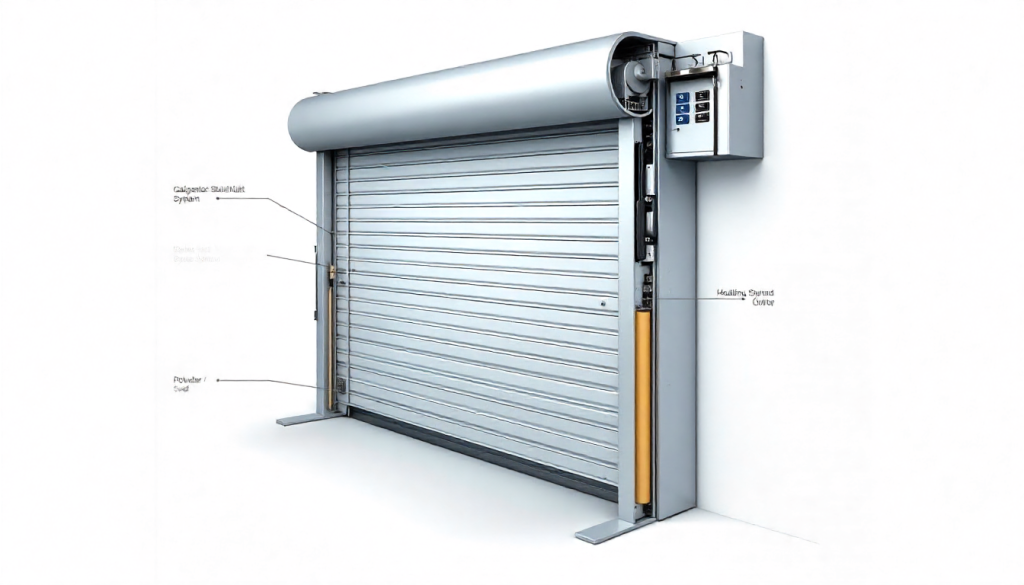
Assessment Framework
Business type and usage patterns are your starting point. How many times does the door operate daily? Operating hours—standard business hours versus 24/7 operations? Type of traffic through the door—forklifts, trucks, cars, foot traffic?
Single door versus multiple doors affects reliability planning. Is the door critical to operations or secondary access?
Budget considerations extend beyond purchase price. What’s your initial investment capacity? More importantly, what’s your 20-year total cost of ownership perspective?
Is maintenance budget available for preventative care? Do you have emergency repair contingency in your budget? What’s the potential energy cost impact for insulated versus non-insulated doors?
Remember: lifecycle costs matter more than purchase price. A $5,000 door costing $2,000 in additional maintenance over 10 years is more expensive than an $8,000 door needing only $500 in maintenance.
Environmental factors specific to your Sutherland Shire location matter tremendously. Coastal versus inland location makes huge difference in material selection. Building exposure to direct sun, wind, and rain?
Is your area industrial with pollution accelerating corrosion? Do you need temperature-controlled environment capabilities? What’s your storm exposure risk based on building location and orientation?
Aesthetic requirements influence door type and material. Is this customer-facing or back-of-house? Corporate image considerations for client-facing businesses. Architectural constraints of your building. Color and finish options needed to match or complement your building.
Do you need window or vision panels for natural light or aesthetics?
Energy efficiency priorities determine insulation needs. How important is climate control to your operation? What are your specific insulation requirements?
Operating cost reduction goals over the door’s lifetime. Are you seeking green building certifications like NABERS or Green Star? What’s your ROI timeline for efficiency investments?
Maintenance capacity affects which door type makes sense. Do you have in-house maintenance staff? Budget available for professional service? What’s your downtime tolerance—can you afford 4-8 hours of unplanned downtime?
Proximity to service providers matters for emergency response. How important is parts availability? Can you wait days for parts or do you need same-day availability?
Questions to Ask Before Purchasing
What is the expected cycle life? Get specific numbers, not vague “long-lasting” claims. Understand how warranty coverage relates to cycle counts. Verify whether the rating is based on testing or just manufacturer estimates.
What is the complete warranty coverage? Get details on each component separately. What’s covered for coastal environments specifically? What actions void the warranty? Is the warranty transferable to future property owners?
What are annual maintenance requirements and costs? How often is professional service needed? What are estimated annual maintenance costs? Which tasks can you do yourself? Are service agreements available?
How long will installation take and what’s the downtime? Critical for planning around operations. Can installation occur after hours or weekends? What temporary closure solutions are available during installation?
What’s the track record for this door type in coastal environments? Ask for local references in Sutherland Shire. Request proof of corrosion resistance in salt air. Any specific examples from Cronulla, Bundeena, or other coastal areas?
What are lead times for replacement parts? How quickly can critical components like springs and motors be obtained? Is emergency part availability guaranteed? Local stock versus special order from interstate or overseas?
Is local service and support available? Does the manufacturer have Sutherland Shire service coverage? What’s the guaranteed emergency response time? Is after-hours service available? What training and certification do technicians have?
What’s the total cost of ownership over 20 years? Calculate installation cost plus energy costs (or savings for insulated doors) plus maintenance costs plus expected major repairs plus replacement timeline. This is the real cost, not just the purchase price.
Next Steps: Not sure which door is right for your business? We offer complimentary on-site assessments where we evaluate your specific requirements and provide customized recommendations. No pressure, no obligation—just expert advice from people who’ve seen thousands of installations across Sutherland Shire.
Your Partner for Commercial Door Reliability
Choosing the most reliable commercial garage door type comes down to matching door characteristics to your specific application. Steel roller doors deliver proven reliability for industrial applications where insulation isn’t critical. Sectional doors provide the best combination of longevity, energy efficiency, and aesthetic appeal for customer-facing operations and climate-controlled facilities. High-speed doors solve specific problems for high-traffic operations where cycle counts and energy efficiency justify the premium investment.
For Sutherland Shire businesses, coastal environment considerations aren’t optional—they’re essential. Material selection, protective coatings, and maintenance frequency must account for salt air, UV exposure, and humidity. The door that works perfectly inland might fail prematurely at the coast without proper specifications.
The most reliable commercial garage door type for your business is the one that’s properly specified for your usage patterns, correctly sized for your opening, constructed from appropriate materials for your environment, backed by a reputable manufacturer, professionally installed by certified technicians, and properly maintained according to the manufacturer’s recommendations.
We’ve been helping Sutherland Shire businesses make these decisions for years. From small retail operations in Cronulla to major distribution centers in Kirrawee, we understand the unique challenges local businesses face. Our team provides expert installation, reliable service, and ongoing support to keep your doors operating reliably for decades.